

Claude Opus 4.8 vs Claude Opus 4.7: Which One Should You Use in 2026?
Meta title: Claude Opus 4.8 vs 4.7: Full Comparison, Differences, and Best Use Cases
Meta description: A deep comparison of Claude Opus 4.8 vs Claude Opus 4.7 covering coding, reasoning, context, pricing, memory, tools, and migration guidance.
Suggested URL slug: claude-opus-4-8-vs-4-7-comparison
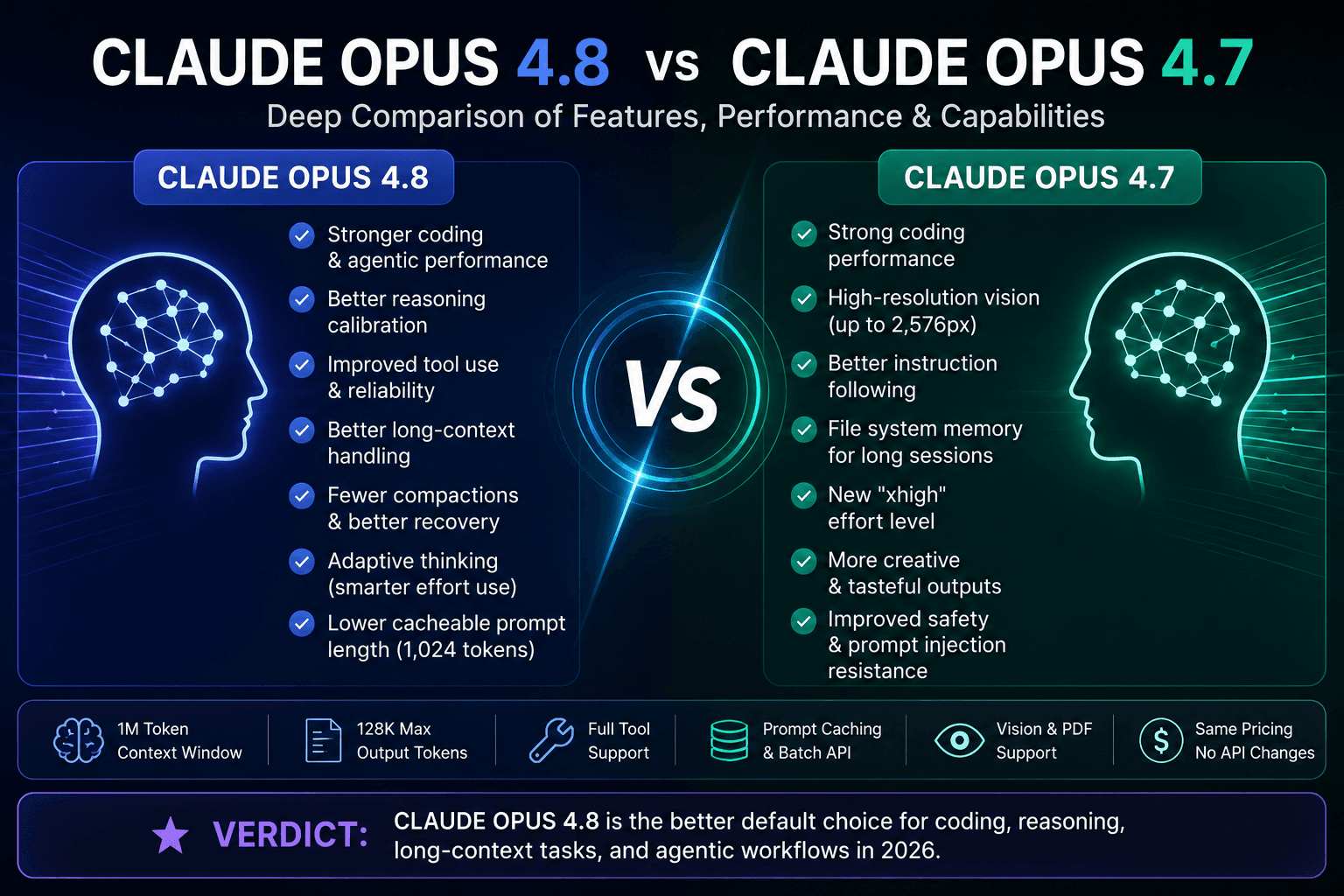
Claude Opus 4.8 is Anthropic’s newest generally available Opus model and builds directly on Claude Opus 4.7. Anthropic says 4.8 is the most capable GA model to date, with stronger performance across coding, agentic tasks, and professional work, while keeping the same overall toolset and platform features as 4.7. In practice, this means the upgrade is less about a dramatic API shift and more about a meaningful quality jump in real work: longer sessions, better long-context handling, more reliable tool use, and smoother collaboration during complex tasks.
The short answer
If you are deciding between the two, Claude Opus 4.8 is the better default choice. Anthropic positions it as the top Opus model for complex reasoning, long-horizon agentic coding, and high-autonomy work. Claude Opus 4.7 is still strong, but it is the earlier version, and 4.8 is explicitly described as an upgrade over it rather than a separate branch of the product line.
What changed from 4.7 to 4.8?
The biggest shift is not a new feature list; it is a refinement of how the model behaves under pressure. Anthropic says Opus 4.8 improves long-horizon agentic coding, reasoning effort calibration, and tool triggering, with fewer cases where the model skips a tool call that the task required. It also uses adaptive thinking to decide when reasoning is needed, which reduces wasted thinking tokens on easier turns compared with Opus 4.7 at the same effort level.
There is also a practical workflow improvement: the minimum cacheable prompt length in Opus 4.8 is 1,024 tokens, lower than in Opus 4.7. That matters for teams using prompt caching, because prompts that were too short to cache in 4.7 can now create cache entries without code changes. Anthropic also says Opus 4.8 inherits the same major platform features as 4.7, including the 1M token context window, 128k max output tokens, adaptive thinking, prompt caching, batch processing, Files API, PDF support, vision, and the full tool set.
Coding performance: 4.8 feels more dependable
Opus 4.7 already made a serious jump in coding. Anthropic described it as a notable improvement on 4.6 for advanced software engineering, especially on the hardest tasks, and highlighted stronger performance on complex, long-running workflows. In one official quote, Anthropic said a 93-task coding benchmark showed 13% higher resolution than Opus 4.6, with faster median latency and stricter instruction following. Anthropic also noted better handling of multi-step workflows and better consistency in long-context work.
Opus 4.8 keeps that direction but makes it feel more production-ready. Anthropic says it has stronger performance across coding and agentic tasks, with better long-context handling, fewer compactions, and better compaction recovery. That is the kind of upgrade developers notice most when they are not doing a single prompt-and-answer interaction, but working through an evolving task over many turns. In other words, 4.7 was strong at the top end; 4.8 is smoother in the messy middle where real projects live.
Agentic work: 4.8 is the safer bet for long sessions
This is where the comparison gets interesting. Opus 4.7 already improved long-running, multi-step work and file system-based memory. Anthropic said it remembers important notes across long, multi-session work and uses them to reduce the need for upfront context. That made it better for tasks where the model had to keep track of goals, assumptions, and prior steps over time.
Opus 4.8 takes that foundation and tightens the screws. Anthropic says it is better at long-horizon agentic coding, reasoning calibration, and tool triggering, and that it has better behavior with long-context handling and compaction recovery. For users, that usually translates into fewer interruptions, fewer “forgot what we were doing” moments, and less babysitting during complicated workflows.
Vision, docs, and professional work
Opus 4.7 also brought a meaningful vision upgrade. Anthropic said it could accept higher-resolution images, up to 2,576 pixels on the long edge, and called out benefits for reading dense screenshots, extracting data from diagrams, and using pixel-precise references. It also said 4.7 was more tasteful and creative for professional tasks, producing higher-quality interfaces, slides, and documents.
Opus 4.8 keeps the same high-resolution image support and expands on the professional-work angle. Anthropic’s own wording emphasizes “coding, agentic tasks, and professional work,” plus better consistency for long-running work. So if your team uses Claude for UI thinking, documentation, analysis, slide creation, or mixed text-plus-vision workflows, 4.8 is the stronger recommendation simply because it preserves what worked in 4.7 while improving reliability.
Pricing and API compatibility
Here is the part many teams care about most: pricing is unchanged. Anthropic lists Opus 4.8 and Opus 4.7 at the same pricing tier, with the same base input, cache write, cache hit, and output token pricing on the official pricing page. Anthropic also says there are no breaking API changes for code already running on Opus 4.7, and that the new model supports the same set of tools and platform features.
That means the upgrade path is relatively clean: change the model name from claude-opus-4-7 to claude-opus-4-8, re-check effort settings, and re-baseline latency and cost. Anthropic specifically notes that the default effort is high, that xhigh may be better for coding and high-autonomy work, and that effort levels were recalibrated in 4.8 compared with 4.7.
4.7 still matters
It would be a mistake to treat 4.7 as obsolete. It introduced several important improvements of its own, including a new xhigh effort level, better high-resolution vision, better file system memory, and stronger instruction-following in long-running workflows. Anthropic also described 4.7 as a step up in safety and honesty, with better resistance to prompt injection on some measures. For teams already tuned around 4.7, it remains a capable model and a useful benchmark for understanding how much 4.8 improves the experience.
Which one should you use?
Use Claude Opus 4.8 if your work depends on coding accuracy, tool use, long sessions, and agentic reliability. It is the better default for production apps, dev workflows, and professional knowledge work because it keeps the same broad platform surface while improving consistency and long-context behavior. Use Claude Opus 4.7 mainly if you are maintaining an existing setup, comparing behavior against a known baseline, or need to understand how the newer model changes your token and effort patterns. Anthropic’s own migration guidance says code that runs on 4.7 should continue to work on 4.8 without breaking changes, but also recommends re-evaluating effort and cost/latency tradeoffs after switching.
Final verdict
Claude Opus 4.8 is not just “a little better.” It is a more refined version of the same class of model: faster to work with, more dependable on long tasks, better at deciding when to think, and better suited to real-world agentic workflows. Claude Opus 4.7 laid the groundwork by improving coding, memory, and multimodal capability; Opus 4.8 takes that foundation and makes it more practical, more stable, and easier to deploy at scale. If you are choosing one model for serious use in 2026, 4.8 is the one to pick.
1. Is Claude Opus 4.8 better than 4.7?
Yes, Anthropic says Opus 4.8 improves coding, reasoning calibration, tool triggering, and long-context handling over Opus 4.7.
2. What changed in Claude Opus 4.8?
Opus 4.8 improves long-horizon coding, reasoning effort calibration, and tool reliability while keeping the same major platform features.
3. Does Claude Opus 4.8 cost more?
No. Anthropic launched Opus 4.8 at the same pricing tier as its predecessor.
4. Which Claude model is best for coding?
For 2026, Claude Opus 4.8 is positioned as Anthropic’s strongest generally available model for coding and agentic workflows.
Anthropic officially says Opus 4.8 improves coding, reasoning, tool use, and long-context behavior over Opus 4.7 while keeping the same core platform capabilities.
What Claude Opus 4.8 vs Claude Opus 4.7: Deep Comparison , Pricing India means in India
Write this section here.
How to use claude opus 4.8 vs claude opus 4.7: deep comparison , pricing step by step
Write this section here.
Common mistakes to avoid with Claude Opus 4.8 vs Claude Opus 4.7: Deep Comparison , Pricing India
Write this section here.
Best tools and resources for AI tools for India
Write this section here.
Final checklist before you publish or apply this
Write this section here.