
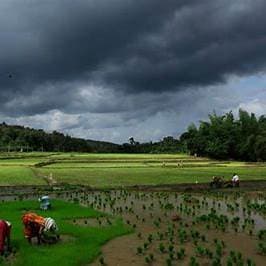

Every year, when the southwest monsoon arrives over Kerala's coast in early June, it carries with it the fate of the Indian economy for the next twelve months. In 2026, the monsoon arrived carrying a warning.
India's official seasonal forecast from the India Meteorological Department placed rainfall at around 90% of the long-period average, with an 84% probability of below-normal or deficient rainfall across the country. Reuters reported that India could be heading toward its weakest monsoon in 11 years — a statement that immediately triggered concern across agriculture, finance, and policy circles.
This is the kind of forecast that sounds abstract until it becomes personal. And for most Indians — whether they farm land or buy vegetables at the local sabzi mandi — it will become very personal over the coming months.
Why the 2026 Monsoon Forecast Matters More Than Usual
India is not new to weak monsoon years. The country has experienced deficient seasons in 1987, 2002, 2009, 2014, and 2023 — each time, the economy absorbed the shock through a combination of government intervention, buffer stocks, and the natural resilience of Indian agriculture.
But 2026 carries a specific set of vulnerabilities that make the forecast more worrying than usual. First, the 2025 monsoon was already patchy, leaving reservoir levels in several major river basins below their 10-year average entering this season. Second, global food prices have been elevated due to supply disruptions in key producing regions. Third, India's food inflation was already running above comfortable levels in early 2026, leaving less room to absorb a supply shock.
The IMD's 84% probability estimate for below-normal rainfall is also unusually high. Most years, forecasters hedge with wider confidence intervals. A probability that strong suggests a clearer signal in the underlying atmospheric data — specifically, weakening La Niña conditions and warm sea surface temperatures in parts of the Indian Ocean that typically reduce convection and moisture delivery over the subcontinent.
What 'Below-Normal Monsoon' Actually Means on the Ground
When the IMD says rainfall will be below normal, it means the country as a whole is likely to receive less than 90% of the long-period average. But that national figure masks enormous regional variation — and it is the regional distribution that determines where the pain is felt most acutely.
In a below-normal year, the deficit is rarely uniform. Some districts receive close to normal rainfall while others receive 60–70% or less. The problem is that the most vulnerable districts — those with limited irrigation infrastructure, high dependence on kharif crops, and low financial buffers — tend to be concentrated in rain shadow zones and rain-fed agricultural belts of central and peninsular India.
Farmers in Vidarbha, Marathwada, parts of Karnataka, Rajasthan, and eastern Madhya Pradesh face a structurally worse outcome in weak monsoon years because they have fewer alternatives. They cannot simply switch on a pump to compensate for rainfall shortfall the way farmers in Punjab or Haryana can.
For these farmers, a weak monsoon is not just an inconvenience — it is a direct threat to income and livelihood. And the downstream effects reach everyone else through the price of food.
How the Monsoon Moves Through the Food System
The connection between monsoon performance and food prices operates through a clear, predictable chain that plays out over four to six months after the season begins.
It starts with sowing. In June and July, farmers across India plant their kharif crops — paddy, soybean, groundnut, cotton, tur dal, moong, and dozens of other varieties. The timing and completeness of sowing depends heavily on how well the early monsoon delivers moisture.
A delayed or weak onset leads to delayed sowing, reduced area under cultivation, and higher input costs as farmers wait for rain and use supplementary irrigation where available. Early sowing data from the Ministry of Agriculture gives the first clear signal of whether the kharif season is on track.
From August onward, mid-season rainfall determines yield quality. Moisture stress during grain-filling or pod-development stages can cut yields by 15–30% in affected districts even when sowing was completed on time. By October, the harvest data begins to arrive — and with it, the first clear picture of how much food the 2026 kharif season will actually produce.
Retail prices respond with a lag of two to three months. The onion prices that spike in November and December, the dal prices that rise in January — these trace back to monsoon performance in June and July. That is the delay that makes it hard for households to prepare, but entirely predictable for anyone watching the early data.
Crops Most Likely to Be Affected in 2026
| Crop | Season | Price Impact Risk |
|---|---|---|
| Tur Dal (Pigeon Pea) | Kharif | Very High |
| Onion | Kharif + Rabi | Very High |
| Soybean / Edible Oils | Kharif | High |
| Paddy (Rain-fed) | Kharif | High (non-irrigated zones) |
| Groundnut | Kharif | Medium-High |
| Wheat | Rabi (winter) | Low (depends on rabi season) |
| Rice (Punjab/Haryana) | Kharif | Low (canal-irrigated) |
The crops at highest risk are those grown in rain-fed areas of central and western India. Tur dal in particular has historically been the most inflation-sensitive crop during weak monsoon years, with retail prices in bad years sometimes doubling from their pre-season levels.
What This Means for Urban Households
If you live in a city, you might wonder how a rainfall shortfall in Vidarbha or Karnataka ends up affecting your grocery bill in Pune or Bengaluru. The answer is straightforward: urban food supply chains are intimately linked to rural production zones, and there is no alternative source for most vegetables and pulses.
India does import pulses when domestic production falls short, but import volumes take weeks to arrive after government policy decisions and global shipping logistics. In the interim, retail prices spike — and they do not always come back down quickly even after imports arrive, because trader psychology and household hoarding reinforce the upward pressure.
For middle-income urban households, a 20–30% rise in the cost of pulses, vegetables, and cooking oil adds up to a meaningful monthly budget increase. A family spending ₹6,000 per month on food could see that figure rise to ₹7,500–8,000 during a sustained food inflation period — without changing what they eat at all.
That is money not available for other spending. For families managing EMIs — on home loans, car loans, or consumer credit — this kind of food inflation adds real pressure. Use Inclaw's free EMI calculator to track how much of your income is already committed to fixed loan payments, and plan your food budget around the remaining discretionary spend.
Government Response: What to Expect
India's government has a well-established playbook for managing food inflation during weak monsoon years. The tools are imperfect but meaningful.
Buffer stock releases through the Food Corporation of India help stabilise rice and wheat prices — the two most widely consumed staples — by ensuring retail availability even when open market supply contracts. The National Food Security Act distribution network reaches over 800 million beneficiaries, providing a floor of food security for the most vulnerable households.
For vegetables and pulses — where the government has fewer direct levers — the typical response includes reducing import duties, cracking down on hoarding and speculation, and coordinating with state governments to ensure smooth interstate movement of perishables. These measures work, but they take time.
What the government cannot fully control is the first month of price spikes, which typically happen before policy measures kick in and before import shipments arrive. That first month is where household budgets feel the sharpest pain.
How to Use This Information Practically
The 2026 monsoon warning is public information, which means you can plan around it. Here is what that looks like in practice.
Watch the IMD weekly rainfall reports, published every Wednesday during the monsoon season. Districts showing cumulative deficits of 20% or more by mid-July are the ones likely to produce the most significant crop stress and subsequent price increases. These reports are free and publicly available on the IMD website.
Consider building a modest pantry buffer of non-perishable essentials — cooking oil, pulses, cereals — in June and July, before the harvest shortfall becomes clear and before prices respond. You do not need to stockpile, but buying a few extra kilograms of tur dal in July at ₹120/kg is better than buying it in November at ₹180/kg.
Track your household expenses carefully this season. Free tools like Inclaw's GST calculator can help you understand the true all-in cost of purchases, and budgeting through a period of elevated inflation requires more visibility into spending than most households typically maintain.
Frequently Asked Questions
What is the India monsoon forecast for 2026?
The India Meteorological Department's 2026 southwest monsoon forecast places seasonal rainfall at around 90% of the long-period average, with an 84% probability of below-normal or deficient rainfall. Reuters reported this could be India's weakest monsoon in 11 years, raising significant concerns about food production and inflation.
How will the 2026 monsoon affect farming in India?
Farmers in rain-fed regions of central and peninsular India face the greatest risk. Delayed or below-normal rainfall reduces sowing coverage, increases crop stress during growth stages, and compresses yields. The most affected crops are tur dal, soybean, groundnut, onion, and rain-fed paddy in states like Maharashtra, Karnataka, and Madhya Pradesh.
Will food prices rise due to the 2026 monsoon forecast?
A below-normal monsoon creates a clear risk of food price increases, particularly for pulses, vegetables, and edible oils. The price impact typically becomes visible 3–4 months after the monsoon season ends, when harvest data confirms supply shortfalls. Analysts expect food inflation could rise to 5.5–6% if the forecast materialises as expected.
Which Indian states are most affected by a weak monsoon?
Maharashtra's Vidarbha and Marathwada regions, large parts of Karnataka, Rajasthan, eastern Madhya Pradesh, and parts of Andhra Pradesh are most vulnerable. These areas have high dependence on rain-fed agriculture and limited irrigation infrastructure compared to northwestern states like Punjab and Haryana.
What steps can Indian households take to prepare for food inflation?
Building a modest pantry buffer of non-perishables like pulses and cooking oil in June–July, tracking weekly IMD rainfall data to anticipate which crops face stress, reducing reliance on the most price-volatile items, and using free budgeting tools to maintain clear visibility over monthly expenses are all practical steps households can take.
The Outlook: Watch, Adapt, and Plan Ahead
The 2026 monsoon forecast carries enough weight to take seriously — but not enough to trigger alarm. India has navigated weak monsoon years before, and the combination of buffer stocks, import flexibility, and government policy tools provides meaningful protection against the worst outcomes.
What the forecast does demand is attention and preparation. Households, farmers, businesses, and policymakers who use the next few weeks to understand the risk and build appropriate buffers will be much better positioned than those who wait for prices to spike before reacting.
The monsoon will do what it does. Your response to it is entirely in your control.