
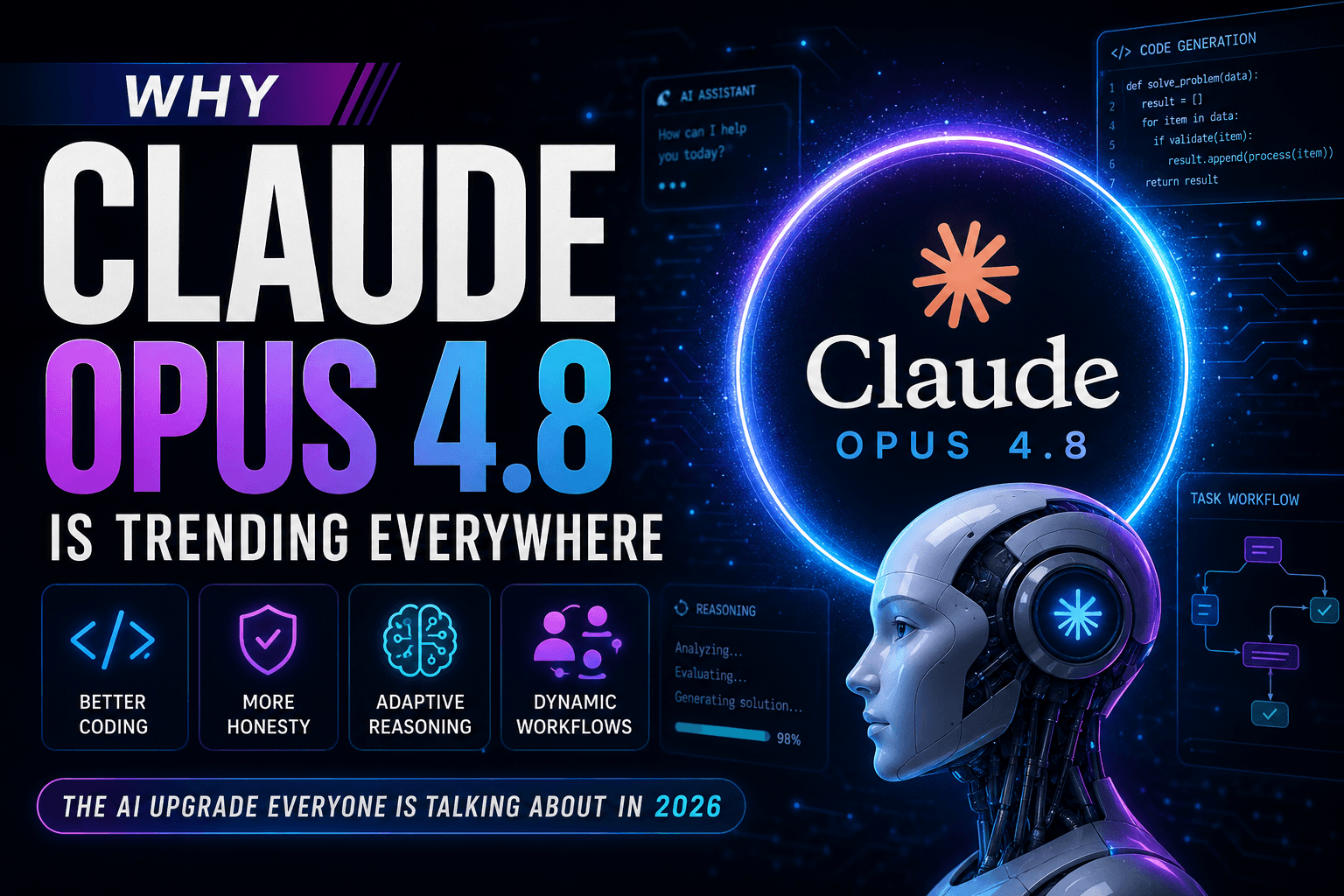

f you’ve been on tech Twitter/X, Reddit, YouTube, or AI communities recently, you’ve probably noticed one name everywhere: Claude Opus 4.8.
So why is everyone suddenly talking about it?
Short answer: it’s not just another model update. Anthropic positioned Opus 4.8 as a smarter, more reliable, more “honest” flagship AI with stronger coding abilities, effort controls, and new multi-agent workflows — and people are debating whether it actually feels more useful than competitors.
Here’s what’s driving the hype.
1. It launched only weeks after Opus 4.7
One reason it exploded online is timing.
Anthropic released Opus 4.8 just 41 days after Opus 4.7, which is unusually fast for a flagship upgrade. That immediately created attention because fast releases usually signal competitive pressure and meaningful changes.
In AI, speed matters.
When a company ships a flagship update quickly, people assume:
performance got better,
earlier complaints are being fixed,
or competition is heating up.
That alone creates social momentum.
2. Better coding = instant developer buzz
The biggest reason Claude Opus 4.8 is trending is developers.
Anthropic says the model improves coding, debugging, reasoning, and agentic workflows. Reports covering the release highlight stronger software engineering performance and better long-running task execution.
Why this matters:
Developers are extremely online.
The moment coding performance improves, people start posting:
benchmark screenshots,
GitHub tests,
“GPT vs Claude” threads,
prompt experiments,
real-world workflows.
That creates massive organic buzz.
Community discussions on Reddit show many users specifically talking about coding quality, token efficiency, debugging, and multi-step execution.
3. “Honesty” became the viral talking point
This is probably the biggest differentiator.
Anthropic heavily marketed Opus 4.8 around better honesty and uncertainty handling.
Instead of confidently making things up, Claude is supposed to:
admit uncertainty more often,
catch flaws,
question weak assumptions,
avoid fake confidence.
Coverage says Anthropic is emphasizing reduced deceptive behavior and stronger self-checking. Some reports describe it as significantly better at admitting when it may be wrong.
That became meme-worthy instantly.
Because for years people complained:
“AI sounds confident even when it’s wrong.”
Now Anthropic is basically saying:
“What if the AI admitted uncertainty?”
That turned into a huge online discussion.
Even Reddit reactions show people joking about Claude suddenly feeling more brutally honest or less “yes-man”-like. Some users liked it, while others found it unexpectedly harsh or overly cautious.
4. Dynamic Workflows = AI agents doing bigger tasks
Another major reason it’s trending is something called Dynamic Workflows.
Anthropic introduced tooling that allows Claude to coordinate many smaller AI “subagents” to solve larger tasks. Coverage describes systems where Claude can split problems, parallelize work, and combine outputs for complex jobs.
Why this matters:
This moves AI from:
“answer my question”
to
“go solve a complicated problem.”
That shift is huge for:
developers,
startups,
automation builders,
productivity creators,
solo founders.
People building SaaS tools and AI agents immediately started testing it.
5. Effort controls became an underrated viral feature
A surprisingly talked-about feature is effort controls.
Users can adjust how much reasoning Claude spends on a task — faster lightweight answers versus deeper, more thoughtful reasoning. Coverage highlights configurable effort levels and better control over compute versus quality tradeoffs.
Reddit users are already discussing this heavily.
One Reddit user said “the feature nobody is talking about” is effort controls because they dramatically affect usefulness depending on the task.
That makes Opus 4.8 feel more customizable than older AI assistants.
6. The internet loves AI comparisons
Another reason it’s trending:
comparison culture.
Everywhere online people are posting:
“GPT-5.5 vs Claude Opus 4.8”
“Claude destroyed GPT for coding?”
“Is Claude finally better than OpenAI?”
“Gemini vs Claude?”
When people compare products, curiosity explodes.
AI audiences love benchmark wars.
Coverage around the release repeatedly frames Opus 4.8 against rival frontier models and notes performance gains in coding, reasoning, and practical work.
That fuels YouTube thumbnails, blog posts, Reddit arguments, and social media threads.
7. Reddit is amplifying both hype and controversy
The most viral thing about Opus 4.8?
People disagree.
Some users love the update and say it feels smarter, less sycophantic, and better for serious work. Others complain it feels too cautious, overly critical, or strange in tone.
That disagreement is actually fuel for virality.
Because controversy spreads faster than agreement.
When people argue:
“This is the best AI ever”
and others say:
“No, this ruined Claude”
…the algorithm wins.
8. Anthropic itself is trending
Part of the buzz isn’t just the model.
It’s the company.
Anthropic has been getting major attention for aggressive AI releases, developer tooling, and growing competition with rivals. That means every flagship launch gets amplified across tech media and creator ecosystems.
In simple terms:
Big company momentum + new flagship + developer hype + controversy = viral trend
Final Answer: Why Claude Opus 4.8 Is Trending Everywhere
Claude Opus 4.8 is trending because it hit multiple viral triggers at once:
Fast flagship release after Opus 4.7
Better coding and reasoning performance
“Honesty” and uncertainty handling became meme-worthy
Dynamic AI workflows feel futuristic
Effort controls changed usability
GPT vs Claude comparison wars exploded
Reddit debates amplified hype and criticism
Anthropic itself is having a big moment in AI news
What Why Claude Opus 4.8 Is Trending Everywhere India means in India
Write this section here.
How to use why claude opus 4.8 is trending everywhere step by step
Write this section here.
Common mistakes to avoid with Why Claude Opus 4.8 Is Trending Everywhere India
Write this section here.
Best tools and resources for AI tools for India
Write this section here.
Final checklist before you publish or apply this
Write this section here.