
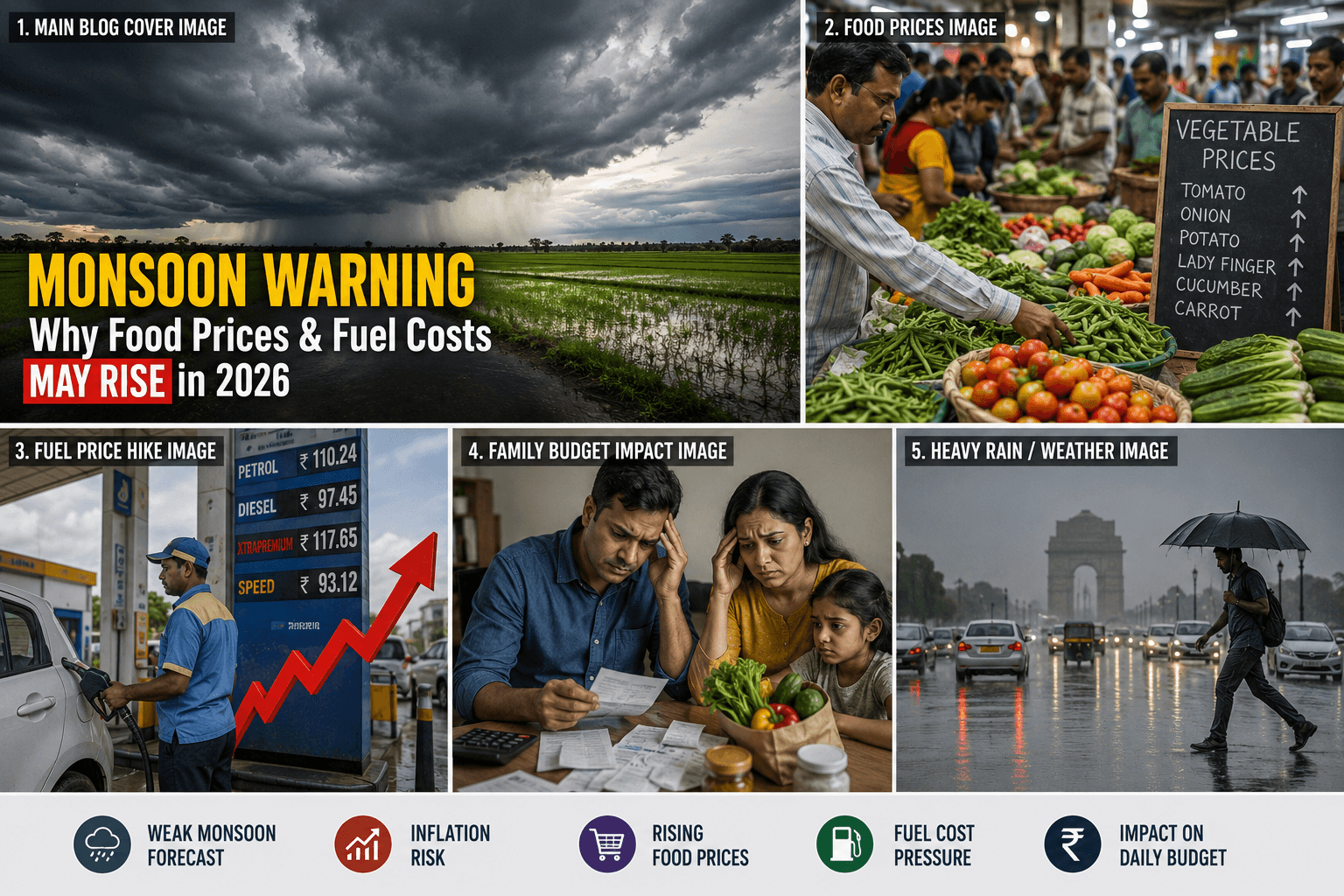

The monsoon arrived late to most of India this year, and the numbers coming out of the India Meteorological Department are making economists nervous. According to the IMD's latest seasonal forecast, the 2026 southwest monsoon is likely to deliver around 90% of the long-period average — well below what farmers, policymakers, and ordinary households were hoping for.
This is not just a weather story. In India, the monsoon is everything. It decides what gets planted, what gets harvested, what ends up on your plate, and what you pay for it. When rainfall underperforms, the consequences ripple through the entire economy — from the fields of Vidarbha to the vegetable markets of Delhi to the fuel pumps of Chennai.
Here is everything you need to understand about what is happening, why it matters, and what it means for your money.
Why India's Monsoon Controls Your Grocery Bill
India receives nearly 70% of its annual rainfall during the June–September southwest monsoon season. For a country where a significant share of agriculture still depends on rain-fed irrigation, this window is critical. When the monsoon performs well, crop output rises, food supply stays steady, and prices remain manageable.
When the monsoon underperforms, the chain reaction is predictable. Sowing gets delayed. Crop yields fall. Supply contracts. And prices — particularly for vegetables, pulses, oilseeds, and cereals — start climbing.
The staples most at risk during a weak monsoon include onions, tomatoes, rice, pulses like tur dal and moong, and oilseeds that feed India's cooking oil supply. These are not premium items. They are everyday essentials that affect every household, regardless of income.
India's Consumer Price Index already showed food inflation running hot in early 2026. A weak monsoon on top of existing price pressure is the kind of combination that keeps the Reserve Bank of India awake at night.
What the 2026 Monsoon Forecast Actually Says
The IMD's pre-season forecast placed the 2026 southwest monsoon at approximately 90% of the long-period average, with an 84% probability of below-normal or deficient rainfall across the country as a whole. That probability figure is unusually high — most years, forecasters hedge with much wider ranges.
Reuters reported that India could be heading toward its weakest monsoon in over a decade, citing concerns about La Niña weakening and rising sea surface temperatures in the Pacific that typically reduce rainfall over the subcontinent.
The IMD has also flagged that below-normal seasonal rainfall is likely across many parts of central and peninsular India — exactly the regions that produce the most critical food crops. Northwestern India and some parts of the northeast may fare slightly better, but the overall picture is one of stress.
What makes this especially concerning is the starting point. India entered 2026 with reservoir levels in several major river basins already running below the 10-year average, following a patchy 2025 monsoon. A second consecutive weak season would compound that deficit significantly.
How a Weak Monsoon Pushes Food Prices Up
The relationship between monsoon performance and food inflation in India is well-documented and consistent. Here is how the transmission works:
Step 1 — Sowing shortfall. When rainfall is delayed or insufficient, farmers in rain-fed areas either delay planting or reduce the area under cultivation. This is especially common for kharif crops like paddy, soybean, groundnut, and cotton, which depend heavily on June and July rainfall to get started.
Step 2 — Yield compression. Even crops that get planted on time face stress if mid-season rainfall is erratic. Moisture stress during critical growth stages — flowering and grain-filling for cereals, pod development for pulses — can cut yields by 15–30% in affected districts.
Step 3 — Supply contraction. When overall crop output falls, the supply available to markets shrinks. Traders, aware of tighter stocks, begin adjusting prices upward even before the harvest comes in. Mandi prices for pulses and oilseeds typically start moving in August and September when early harvest signals reach the market.
Step 4 — Retail price spike. By October and November, the full impact of a weak kharif harvest shows up in retail prices. Pulses like tur dal can see 20–40% price increases in bad monsoon years. Onion and tomato prices, already famously volatile, can spike sharply when growing districts in Maharashtra, Karnataka, and Andhra Pradesh receive insufficient rain.
The Fuel Factor: Double Pressure on Indian Budgets
India's food inflation risk in 2026 does not exist in isolation. It sits alongside rising global fuel prices that are adding a second layer of cost pressure to household budgets.
Fuel price increases affect the cost of agriculture directly — through diesel for pump sets, tractors, and transport — and indirectly through logistics costs that get passed on to consumers at every step of the supply chain. When a truck carrying vegetables from Nasik to Mumbai costs more to operate, that cost ends up in the price of the onion on your kitchen counter.
India's finance ministry has flagged that the combination of below-normal monsoon expectations and elevated global crude prices creates a material inflation risk for the second half of 2026. Economists estimate that food inflation could push overall CPI toward 5.5–6% if both risks materialise simultaneously — a level that would pressure the RBI to hold rates higher for longer.
Which States and Crops Are Most at Risk
| State/Region | Key Crop at Risk | Risk Level |
|---|---|---|
| Maharashtra (Vidarbha) | Soybean, Cotton, Pulses | High |
| Karnataka | Paddy, Onion, Pulses | High |
| Madhya Pradesh | Soybean, Wheat (rabi) | Medium-High |
| Rajasthan | Bajra, Groundnut | Medium |
| Uttar Pradesh | Paddy (eastern UP) | Medium |
| Punjab, Haryana | Paddy (irrigated) | Low (canal irrigation) |
Irrigated states like Punjab and Haryana are significantly more insulated because they rely on canal networks rather than direct rainfall. The most vulnerable regions are those where farmers depend on rain-fed cultivation with limited access to groundwater irrigation.
What the Government Can and Cannot Do
India has a set of standard policy levers it reaches for during weak monsoon years, and 2026 is likely to be no different. The question is whether these tools are enough.
Buffer stock releases. The government holds substantial stocks of rice and wheat in Food Corporation of India warehouses. Releasing these into the open market — particularly through the National Food Security Act network — helps stabilise retail prices for staples. This tool is most effective for cereals but does nothing for vegetables, pulses, or oilseeds.
Import duty cuts. India has periodically used tariff reductions on pulses and edible oils to allow cheaper imports when domestic supply falls short. These measures can cool prices within weeks of announcement but depend on global markets having adequate supply at competitive prices.
Export restrictions. During the 2022–23 food price spike, India restricted wheat and rice exports to protect domestic availability. Similar measures are possible if 2026 crops underperform severely.
MSP hikes and NREGA allocation. The government may also increase Minimum Support Prices to protect farmer income, while expanding MGNREGA rural employment spending to cushion the income shock in rain-fed agriculture districts.
None of these tools eliminate the impact of a bad monsoon. They manage it. For consumers, especially in urban households spending 30–40% of income on food, a weak monsoon year is simply more expensive.
How to Protect Your Household Budget This Season
If you live in India and are watching these forecasts with concern, there are a few practical steps that can help cushion the impact.
First, consider building a small pantry buffer for non-perishable staples — pulses, rice, cooking oil — before the peak harvest season when prices typically rise. Buying in slightly larger quantities during the July–August period, before the kharif harvest outcome becomes clear, can protect against the worst price spikes.
Second, track the IMD weekly rainfall updates, which are published publicly and updated every week during the monsoon season. Districts receiving 80% or less of their normal rainfall are the ones most likely to see crop stress — and future price pressure.
Third, use free tools like Inclaw's GST calculator and EMI calculator to keep closer track of your real household costs when food and fuel inflation is running hot. Small expense changes compound quickly across a year.
Frequently Asked Questions
How does a weak monsoon affect food prices in India?
A weak monsoon reduces crop output, particularly for rain-fed kharif crops like pulses, oilseeds, paddy, and vegetables. Lower supply with steady or growing demand pushes retail prices upward, typically becoming visible in October and November after the harvest shortfall becomes clear.
Which foods get most expensive during a bad monsoon year?
Pulses like tur dal and chana dal are historically the most volatile. Onions and tomatoes can spike sharply in producing states like Maharashtra and Karnataka. Edible oils — particularly groundnut and sunflower — also rise when oilseed harvests underperform. Wheat and rice are more insulated due to government buffer stocks.
Will the 2026 monsoon definitely be weak?
The IMD forecast gives an 84% probability of below-normal or deficient rainfall, which is significant. However, monsoon forecasting has uncertainty built in — actual performance depends on how La Niña evolves and whether compensating moisture from the Bay of Bengal arrives during the season. The situation can improve, particularly in August and September.
How does fuel price affect food inflation in India?
Higher fuel prices directly increase the cost of farming (diesel for pump sets and tractors) and logistics (trucks transporting food from farm to market). These costs get passed through to retail prices, often adding 3–8% to the final price of produce even before any supply shock from poor rainfall.
What can I do to manage my budget during a high food inflation period?
Building a modest buffer of non-perishable items before peak price season, shifting to seasonal vegetables (which tend to be better supplied and cheaper), reducing processed food expenditure, and tracking household spending carefully using free digital tools are all practical responses. Buying in bulk during periods of stable prices can also reduce the annual impact significantly.
Does the Indian government take action to control food prices during a weak monsoon?
Yes — the government typically uses buffer stock releases through FCI, import duty reductions on pulses and edible oils, export restrictions on key commodities, and expanded rural employment schemes to manage the economic impact. These tools moderate but do not eliminate the price impact of a genuine shortfall.
The Bottom Line
The 2026 monsoon warning is real, and its implications for food prices are something every Indian household should be paying attention to. The combination of below-normal rainfall expectations, existing inflation pressure, and rising global fuel costs creates a difficult environment for the second half of the year.
That does not mean panic or bulk-buying everything in sight. It means watching the weekly rainfall data, understanding which foods are most exposed, and making smart, small adjustments before prices peak. India has navigated weak monsoon years before — with the right information, so can your household.