


Your resume is a marketing document, not a legal transcript of everything you did from 9 to 5. When recruiters stare at a stack of 500 applications in their Applicant Tracking System (ATS), they do not read paragraphs. They scan bullets.
If your bullets start with "Responsible for" or "Helped with," the ATS might technically parse your document, but the human recruiter will immediately skip over it. Generating ATS-friendly resume bullets isn't about stuffing your page with invisible white text; it is about using a specific structural formula that proves your competence in seconds.
Whether you are trying to clean up a messy work history or translate non-corporate experience into a professional format, you need a system. Here is the exact formula to turn weak, generic statements into interview-generating resume bullets.
Why Your Current Resume Bullets Get Ignored
Before we fix your resume, we need to understand why it is currently failing. Most job seekers write their resumes like job descriptions. They list out the basic requirements of their role and assume the hiring manager will figure out the rest.
Example of a bad bullet: "Responsible for managing the cash register and helping customers."
This tells the recruiter nothing. It proves you existed at a job, but it doesn't prove you were any good at it. Furthermore, it lacks any of the hard keywords that an ATS is looking for when filtering candidates for a customer success or sales role.
A strong bullet point must answer three questions instantly:
- What did you actually do? (Action)
- How big was the project or problem? (Scope)
- Why did it matter to the business? (Result)
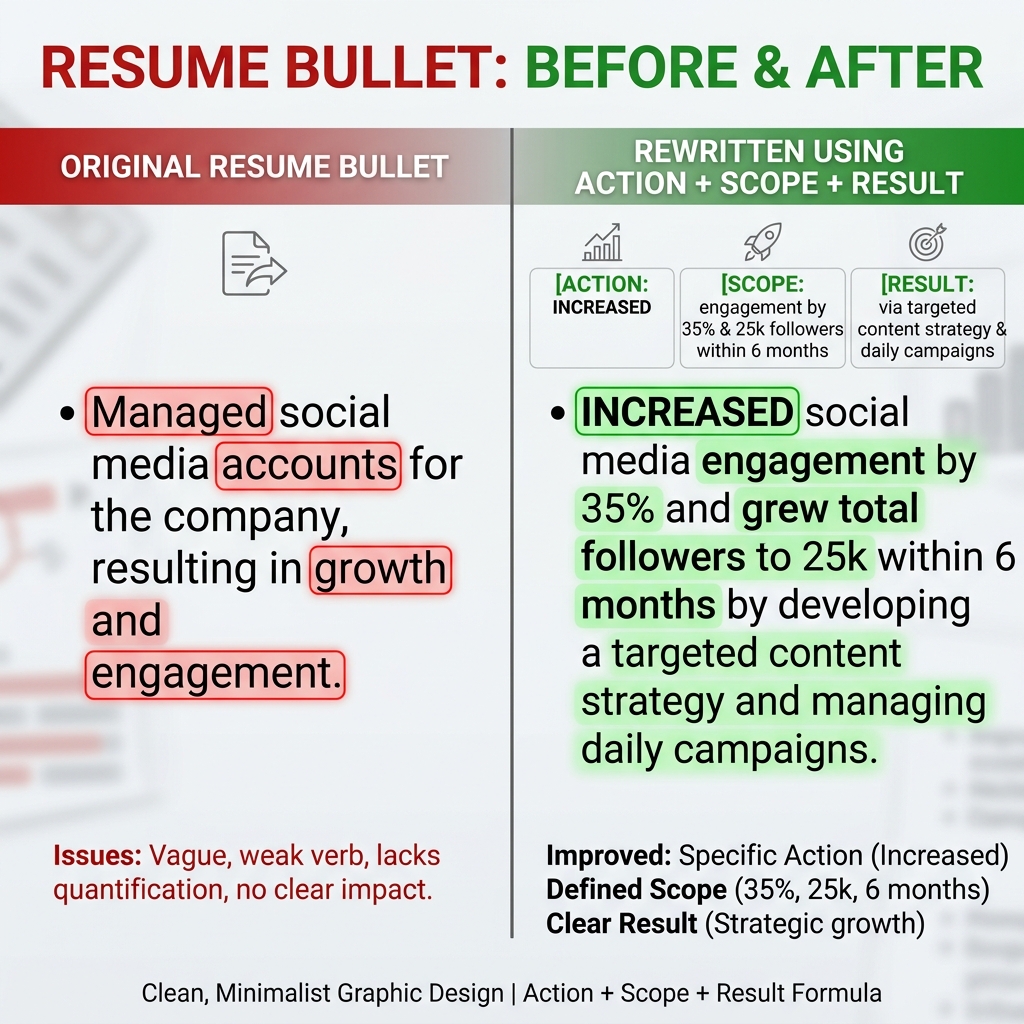
The Simple Formula: Action + Scope + Result
You do not need to be a professional copywriter to build a great resume. You just need to follow a strict formula. Every single bullet on your resume should follow this structure:
1. The Action (Start Strong)
Never start a bullet with "Worked on," "Assisted with," or "Responsible for." Start with a strong, active verb that dictates ownership. If you managed a project, use "Orchestrated," "Directed," or "Spearheaded." If you fixed a problem, use "Resolved," "Engineered," or "Streamlined."
2. The Scope (Give Context)
Scope provides the scale of your work. Without numbers, your claims are hollow. If you managed a budget, how big was it? If you led a team, how many people? If you wrote code, how many users interacted with it? Adding scope (e.g., "a $2M budget," "a 12-person cross-functional team," "a database of 10,000 clients") immediately grounds your bullet in reality.
3. The Result (Prove Impact)
This is where 90% of applicants fail. You must tie your action to a business outcome. Did you save time? Did you make money? Did you reduce errors? Whenever possible, quantify this. (e.g., "resulting in a 15% increase in Q3 revenue," "saving 10 hours of manual data entry per week.")
Case Study: Transforming Weak Bullets
Let's look at how this formula works in practice. We will take three messy work histories and turn them into ATS-friendly bullets that actually sound natural.
Example 1: The Retail Worker (Transitioning to Corporate)
When moving from retail or service into an office job, candidates often struggle to translate their skills. They assume retail work "doesn't count." It absolutely does, if you frame it correctly.
The Bad Bullet: "Helped customers find clothes, ran the cash register, and trained new people."
The ATS-Friendly Bullet: "Resolved 50+ daily customer inquiries during peak holiday volume, maintaining a 100% positive satisfaction rate while training two new associates on POS software."
Why it works: It highlights volume (50+ daily), quality (100% satisfaction), and technical aptitude (POS software), which are critical keywords for customer success roles.

Example 2: The Junior Marketer
Junior employees often downplay their impact because they didn't "own" the entire strategy. You don't have to be the CMO to have a great bullet point.
The Bad Bullet: "Posted on the company's Instagram and grew our followers."
The ATS-Friendly Bullet: "Executed a 3-month organic content strategy across Instagram and TikTok, driving a 45% increase in follower growth and generating 120 new inbound leads."
Why it works: It defines the timeline (3 months), names the platforms (ATS keywords), and provides hard metrics for the outcome (45% increase, 120 leads).
Example 3: The Project Coordinator
Project managers often fall into the trap of just listing the software tools they used without explaining what they actually achieved with them.
The Bad Bullet: "Responsible for making sure the design team met deadlines using Jira."
The ATS-Friendly Bullet: "Directed weekly sprint planning for a 5-person design team using Jira, reducing project delivery delays by 20% over a six-month period."
Why it works: It specifies the team size, the methodology (sprint planning), the tool (Jira), and the specific business value (reducing delays by 20%).
Keywords That Matter (And Keywords to Skip)
When trying to pass an ATS, many applicants stuff their resumes with soft skills. This is a mistake. The ATS is not looking for "Team player," "Detail-oriented," or "Hard worker." Those are subjective traits.
The ATS is programmed to look for hard skills and nouns. If you are applying for a B2B sales role, the ATS wants to see "Salesforce," "Outbound Prospecting," "Cold Calling," and "CRM."
How to find the right keywords: Print out the job description. Highlight every piece of software, every specific methodology (like Agile or Lean), and every core competency they list. Ensure those exact words appear organically within your Action + Scope + Result bullets.

How to Keep It Honest Without Sounding Small
A common fear when using this formula is the feeling of exaggeration. "I didn't increase revenue by $1 million, I just organized some files. How do I quantify that?"
You do not need to lie. If you didn't drive massive revenue, don't claim you did. Instead, focus on frequency, volume, and time saved.
If you reorganized a messy, shared Google Drive for your team, you might think that's too small to mention. But think about the impact: you likely saved your 5-person team about an hour of searching for documents every week. Over a year, that is 260 hours of recovered productivity.
The Bullet: "Restructured the departmental Google Drive architecture for a 5-person team, eliminating data silos and recovering an estimated 5 hours of weekly productivity."
Edit for truth first. If the bullet is honest, then you can tighten the language to make it sound professional.
The Best AI Prompt for Generating ATS Bullets
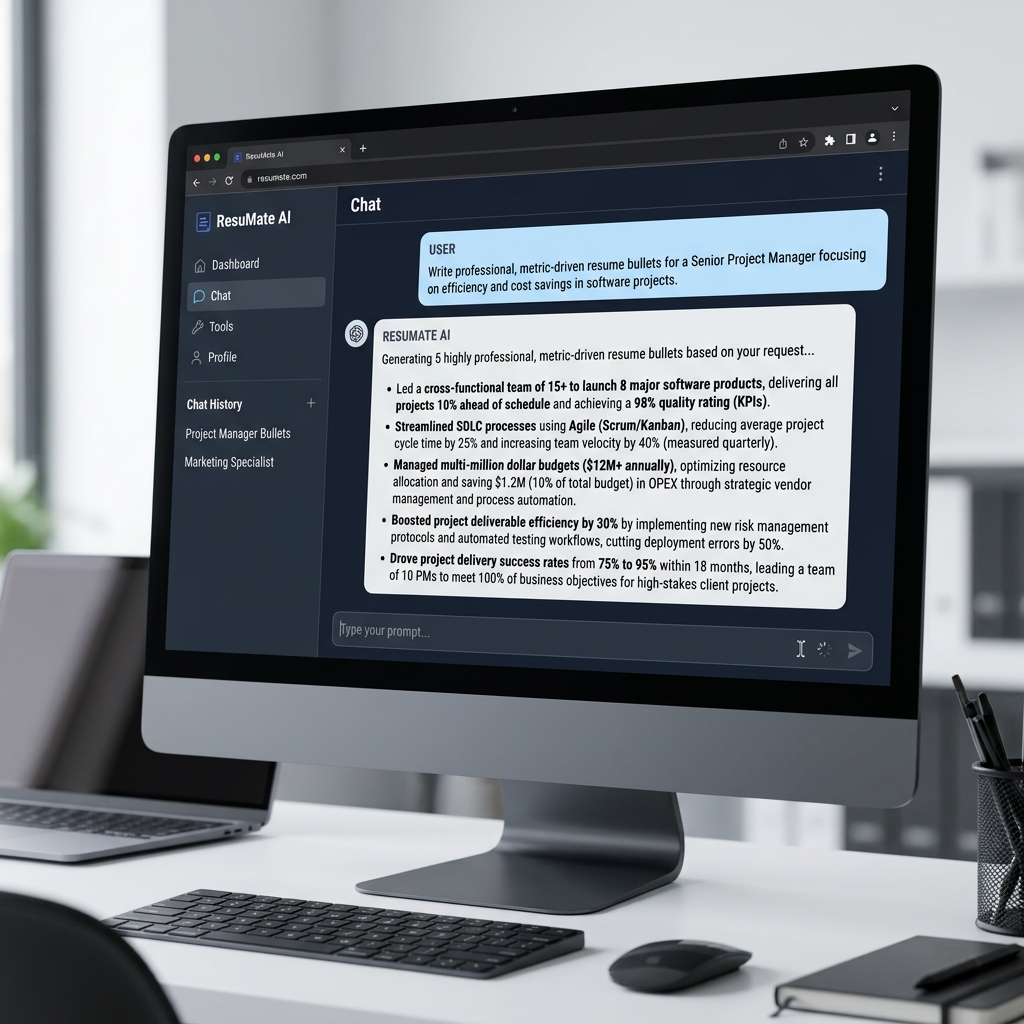
If you have a messy list of tasks and want to generate clean bullets quickly, you can use AI tools like Claude or ChatGPT. However, you must constrain the AI, or it will generate robotic, unbelievable text.
Copy and paste this prompt:
"Act as an expert resume writer. Take this messy list of tasks I did at my last job and turn them into 3 ATS-friendly bullets. Follow these rules strictly: Use the Action + Scope + Result formula. Start every bullet with a strong action verb. Include the numbers and metrics I provide. Do not use cliché words like 'spearheaded', 'delve', 'multifaceted', or 'testament'. Keep each bullet under two lines. Here are my tasks: [Insert your messy notes here]."
Final Proofreading Pass Before Sending
Before you export your resume to PDF, do a final structural check. ATS systems struggle with complex formatting.
- Use standard bullets: Stick to solid black circles or squares. Do not use checkmarks, arrows, or emojis. ATS parsers often read custom icons as errors.
- Check your tenses: If you currently work at the job, the verbs should be present tense (e.g., Manage, Direct). If it is a past job, the verbs must be past tense (e.g., Managed, Directed).
- Kill the periods: In modern resume formatting, bullet points do not need periods at the end of the line. Just be consistent.
By applying the Action + Scope + Result formula, you aren't just pleasing a software algorithm; you are making it incredibly easy for a human recruiter to say "Yes."
For more actionable advice, review our complete [LINK: cover letter guide], prepare your talking points with our [LINK: interview guide], and track your applications using our comprehensive [LINK: job search checklist].