

You found a remote role you actually want. The pay is good, the time zone aligns with your life in Chicago, and the tech stack makes sense. But then you hit the roadblock: the application requires a cover letter.
You know that sending a generic, robotic template is the fastest way to get your resume trashed by a hiring manager. The goal isn't just to write a cover letter—it's to write a cover letter that proves you're a capable human being, quickly. This is where AI cover letter generators come in, provided you know how to use them without sounding like a machine.
We tested the top AI tools by feeding them real US-based remote job descriptions for software engineering, product marketing, customer support, and project management. We didn't just ask for generic drafts; we evaluated them on tone, formatting, and the absence of cringe-worthy AI buzzwords. Here is what actually works when you need to land an interview, not just submit an application.
What Remote Hiring Managers Actually Look For
Before you open ChatGPT or Claude, you need to understand the assignment. Remote hiring managers are not reading cover letters to see if you are a "dedicated professional with a passion for excellence." They are looking for specific signals of competence.
Remote work is fundamentally about trust, proactive communication, and autonomy. When a startup in Austin is hiring a senior developer, they want to know that you can ship code without someone holding your hand over Zoom. When a SaaS company in Seattle hires a customer success manager, they need proof that you can de-escalate angry clients asynchronously.
Here is what the person reading your cover letter is actually scanning for:
- Can you solve our immediate problem? If the job description emphasizes migrating from legacy systems, your cover letter needs to mention a time you successfully managed a messy migration. If they need someone to scale a sales team, talk about a time you built a pipeline from scratch. They don't care about your life story; they care about their immediate business pain.
- Do you write well? In a remote environment, 80% of your communication happens in text—via Slack, Jira, Notion, or email. Your cover letter is essentially a writing test. If your letter is bloated, vague, or overly formal, the hiring manager will assume your Slack messages are going to be just as exhausting to read.
- Are you actually interested in this specific company? Or did you blast the same application to 50 remote postings on LinkedIn? Remote roles get hundreds of applications. If your letter reads like a generic template that could apply to any SaaS company, you will be ignored.
- Do you understand async culture? Remote work requires a specific skill set: the ability to unblock yourself, document your processes, and over-communicate when necessary. Highlighting these soft skills implicitly tells the manager that you won't be a burden to manage remotely.
Side-by-Side Test: The Best AI Cover Letter Generators
Not all AI models write the same way. We put the top contenders through a stress test using a real job posting for a Remote Product Marketer at a B2B SaaS company. Here is how they stack up.
1. Claude 3.5 Sonnet (The Winner for Tone)
If you want a draft that sounds like a smart professional writing an email, Claude is currently unmatched. It naturally defaults to a conversational, plain-English tone. It avoids the grandiose adjectives that other models love to use.
When we prompted Claude with a resume and a job description, it produced a cover letter that felt 80% ready to send. It picked up on the nuances of the remote environment and framed the candidate's past experience in a way that directly addressed the job requirements. It didn't invent fake enthusiasm; it just presented facts clearly. For anyone applying to modern tech companies, startups, or remote agencies, Claude is the superior choice.
2. ChatGPT (GPT-4o)
ChatGPT is incredibly powerful for brainstorming and structural formatting, but it has a massive tone problem out of the box. Unless you heavily constrain it, ChatGPT will write cover letters that sound like a 19th-century aristocrat applying for a knighthood. You will see words like "testament," "unwavering," "delve," and "multifaceted."
To use ChatGPT effectively, you have to provide explicit negative constraints (e.g., "Do not use formal jargon or AI clichés"). Even then, it often requires a heavy human edit to strip out the robotic phrasing. It is excellent at extracting keywords from a job description, but you must rewrite its prose.
3. Specialized Tools (Teal, Kickresume, Jasper)
Tools like Teal and Kickresume are excellent because they integrate the cover letter generation directly into a resume builder and job tracking workflow. They use underlying models (usually OpenAI's API) but wrap them in a UI that forces you to input specific skills and achievements. The output is structurally sound, though you still need to massage the tone.
Jasper, on the other hand, is built for marketers but can be adapted for career writing. It allows for more granular tone adjustments ("witty," "professional," "urgent"), but at its price point, it is overkill for a job seeker.
My opinionated take: Don't pay for a specialized cover letter app if you already pay for Claude Pro or ChatGPT Plus. The raw models, when prompted correctly, yield better writing than the rigid templates most resume builders force you into.
The Fastest Way to Draft a Strong First Version
The biggest mistake job seekers make is using a lazy prompt. If you type, "Write a cover letter for this job description [paste text]," you will get garbage output. You will get a letter that regurgitates your resume in paragraph form, wrapped in flowery language.
To get a usable draft, you need a structured prompt framework. We use the Context-Win-Tone method.
The Context-Win-Tone Prompt Framework
Copy and paste this prompt into Claude or ChatGPT:
"I am applying for the [Job Title] role at [Company Name]. Here is the job description: [paste job description]. Here is my resume: [paste resume]. Write a concise, 300-word cover letter for this role. Follow these rules exactly:
1. Context & Role Fit: Do not summarize my entire career. Focus only on the 2 or 3 experiences from my resume that directly solve the core problems mentioned in the job description.
2. Tone: Write in plain English. Conversational, confident, but not boastful. Write like a smart professional sending an email to a colleague. Use short, punchy sentences.
3. Structure: Do not use a formal address block (no addresses or dates at the top). Start with a strong hook about why my specific background solves their main problem. Use one bulleted list in the middle highlighting three specific metrics from my resume.
4. Constraints: Do not use words like 'delve', 'testament', 'thrilled', 'multifaceted', 'navigate', or 'landscape'. Keep paragraphs under 3 sentences."
This prompt forces the AI to behave like a sharp editor rather than a verbose chatbot. It strips away the fluff and centers the letter around your actual value proposition.
Best Prompts for Different Job Types
Depending on the role you are applying for, you need to instruct the AI to emphasize different soft skills and technical competencies. A marketing cover letter should read very differently from an engineering one.
For Software Engineering Roles
Remote engineering teams care about clean code, async communication, and autonomy. They want builders who don't need constant supervision. Add this to your prompt:
"Emphasize my experience taking ownership of features from ideation to deployment. Highlight my ability to document code clearly and communicate technical tradeoffs asynchronously with product managers. Focus on my experience reducing technical debt and shipping on time in a distributed team environment."
For Customer Support & Success Roles
Support managers want empathy, efficiency, and thick skin. They need people who can handle high volume without burning out. Add this to your prompt:
"Focus heavily on my experience reducing ticket resolution times while maintaining high CSAT scores. Highlight a time I de-escalated a frustrated user or identified a recurring bug that led to a product fix. Keep the tone empathetic but highly organized."
For Project Management Roles
PMs need to herd cats across time zones. They are the glue that keeps a remote team functioning. Add this to your prompt:
"Highlight my ability to align cross-functional teams (design, dev, marketing) in a fully remote environment. Mention my proficiency in agile methodologies and tools like Jira or Linear to keep timelines on track without micromanaging. Focus on a specific launch I managed successfully."
For Marketing & Growth Roles
Growth teams care about one thing: revenue. They don't care about vanity metrics. Add this to your prompt:
"Focus strictly on metrics, conversion rates, and revenue impact. Highlight my ability to run experiments, analyze data, and scale winning campaigns. Ensure the tone is persuasive, data-driven, and demonstrates an understanding of their specific target audience and GTM strategy."
For Freelance & Contract Roles
Freelancers are hired to solve immediate, specific problems without the overhead of onboarding an employee. Add this to your prompt:
"Write this as a direct pitch to the founder. Focus on my ability to step in immediately, audit their current setup, and deliver a specific outcome within 30 days. Emphasize low-friction onboarding and clear deliverables."
The "Sounds Human" Edit Checklist
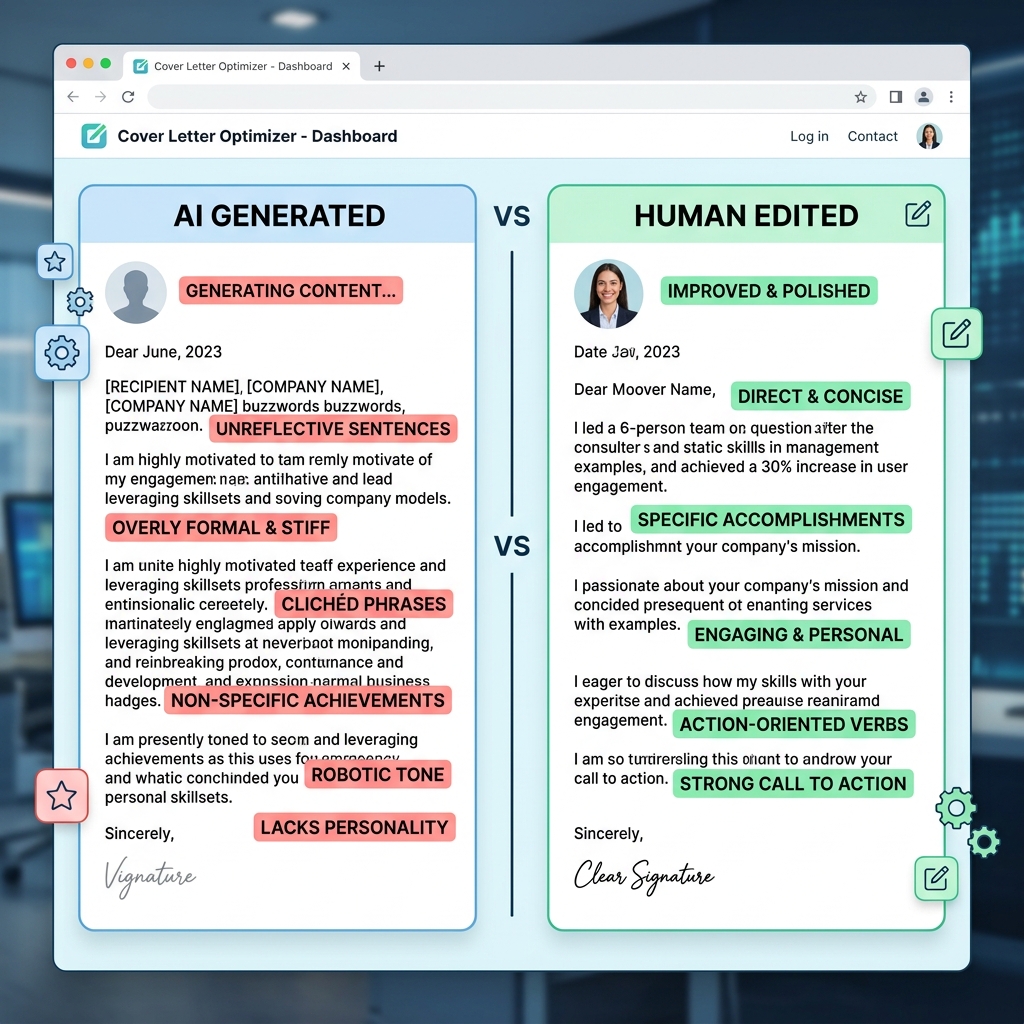
Never send the raw AI output. Ever. You must run the AI draft through a human filter. If you skip this step, you will blend in with the thousands of other applicants spamming the ATS with unedited ChatGPT text.
Before you hit submit, run your draft through this ruthless checklist:
1. Search and Destroy AI Buzzwords
AI models have a predictable vocabulary. They rely on crutch words when they lack real substance. If you see any of the following phrases, delete them immediately and rewrite the sentence in plain English:
- "In today's fast-paced digital landscape..." (Delete entirely; it means nothing.)
- "A testament to my dedication..." (Change to: "This resulted in...")
- "I am uniquely positioned to..." (Change to: "My background in X helps me do Y.")
- "Delve into the complexities..." (Change to: "Analyze" or "Figure out.")
- "Leveraging my multifaceted skills..." (Change to: "Using my experience in...")
2. Kill the Filler Intro
AI loves to start letters with, "I am writing to express my enthusiastic interest in the position of [Role] at [Company]." This is incredibly boring. The hiring manager knows why you are writing. Cut the preamble. Start with a direct statement of value.
Robotic: "I am thrilled to apply for the Senior React Developer role at Acme Corp, a company I have long admired for its innovative approach."
Human: "When I saw Acme Corp was migrating its legacy dashboard to Next.js, I knew I had to apply. I spent the last two years leading a similar migration at [Previous Company], reducing our initial load time by 40%."
3. Add an Opinionated Take
Machines don't have opinions. Humans do. Adding a mild, relevant opinion shows you actually understand the industry and aren't just regurgitating facts. It shows you are an operator, not a theorist.
For example, if you are applying for an SEO role, you might inject a line like: "While many teams are panicked about AI overviews, I've found that doubling down on original entity research is actually driving higher-intent traffic." This single sentence proves you are actively engaged with industry trends.
4. Shorten Your Paragraphs for Skimmability
People read cover letters on screens, often on 13-inch laptops while drinking their morning coffee. Blocky, dense paragraphs are visually intimidating and often get skipped. Break them up. No paragraph should be longer than three sentences. Use bullet points to highlight your strongest metrics so they stand out immediately to a scanning eye.
5. Match the Company Culture
If you are applying to a Web3 startup, the tone should be casual, direct, and technically sharp. If you are applying to a remote healthcare compliance company, the tone should be rigorous, professional, and detail-oriented. AI defaults to a middle-of-the-road "business professional" tone. Tweak the vocabulary to mirror the language they use on their own "About Us" page.

How to Extract Remote-Specific Skills from Past Jobs
One of the biggest hurdles for applicants moving to remote work is proving they can handle the environment. If your past jobs were all in-office, AI might struggle to frame your experience correctly. You need to feed it the right raw material.
Think about how you operated in your previous roles and translate that into remote-friendly terms:
- Did you manage a team across different floors or buildings? That is distributed team management.
- Did you write detailed standard operating procedures (SOPs)? That is asynchronous documentation.
- Did you run cross-departmental meetings? That translates to aligning stakeholders in a distributed environment.
Tell the AI: "Frame my experience managing the logistics department in a way that highlights my ability to document processes and communicate asynchronously, which are critical skills for this remote role."
Before and After: Real Examples of Edited Cover Letters
Let's look at how a raw AI draft transforms after a heavy human edit. Notice how the edited versions strip out the fluff and focus relentlessly on value.
Example 1: The Mid-Career Pivot (Marketing to Product Management)
The Raw AI Draft:
"Dear Hiring Manager, I am writing to express my profound interest in the Product Manager role at your esteemed company. My multifaceted background in marketing has equipped me with a unique perspective on user behavior. I am adept at navigating the complexities of cross-functional collaboration and am a testament to driving strategic growth. I am thrilled at the prospect of leveraging my skills to elevate your product roadmap."
The Human Edit:
"Hi Team,
I'm applying for the Product Manager role because your focus on reducing churn in the enterprise tier caught my eye. For the past three years, I've run lifecycle marketing at [Company], where I realized our biggest retention levers weren't marketing campaigns, but core product friction points.
I transitioned into product management because I wanted to fix those issues at the source. Recently, I led a cross-functional squad to redesign our onboarding flow, which increased month-two retention by 18%.
I know how to balance marketing requests with engineering realities, and I'd love to bring that perspective to your product team."
Why the edit works: It kills the formal jargon, explains the career pivot logically, and grounds the application in a specific, measurable win. It sounds like an email from a competent peer.
Example 2: The Entry-Level Remote Job
The Raw AI Draft:
"As a recent graduate of XYZ University, I am highly motivated to bring my passion for technology to your customer support team. Throughout my academic career, I honed my communication skills and developed a robust work ethic. I am eager to contribute to your company's success."
The Human Edit:
"Hi there,
I'm applying for the Customer Support role. While I recently graduated, I'm not new to managing high-stress communication. I spent the last two years running an online vintage clothing store via Shopify.
Managing my own customers taught me how to handle shipping disputes, de-escalate angry buyers, and maintain a 4.9-star rating across 500+ transactions. I'm comfortable using Zendesk and totally comfortable working independently from my home office in Ohio.
I'd love to bring that same level of ownership to your support queue."
Why the edit works: It replaces vague academic claims with a concrete, relatable side-hustle that proves competence in customer service and an ability to work independently.
Applicant Tracking Systems (ATS) and Cover Letters
A common misconception is that Applicant Tracking Systems (like Workday, Greenhouse, or Lever) use AI to automatically reject cover letters that don't have enough keywords. While ATS software does parse resumes for keywords to rank candidates, cover letters are rarely subjected to the same rigid algorithmic sorting.
However, cover letters are attached to your profile in the ATS. When a recruiter or hiring manager clicks on your profile because your resume passed the initial screen, the cover letter is the very next thing they read.
This means your cover letter is a human-to-human document. You do not need to stuff it with keywords to trick an algorithm. You need to write it to persuade the tired, overworked hiring manager who is reviewing 50 profiles before lunch. Be brief, be specific, and be human.
When to Use a Generator vs. Writing From Scratch
AI is a tool, not a crutch. You need to know when to deploy it and when to rely on your own raw writing skills.
Use an AI Generator When:
- You are staring at a blank page. If you have writer's block, AI is the best remedy. Get a bad first draft on paper so you have something to edit. Editing is always faster than drafting from scratch.
- You need to match tone. If the job description is highly analytical and you naturally write creatively, you can ask AI to analyze your resume and extract only the most data-heavy bullet points to frame your letter.
- You are applying to standard roles. For mid-level corporate roles where a standard, polite email format is expected, AI provides a great structural foundation that you can quickly customize.
Write From Scratch When:
- It is your absolute dream job. If you are applying to a highly creative company (like a top-tier design agency or an early-stage boutique SaaS startup), a standard cover letter won't cut it. You need to write something entirely original, perhaps a teardown of their product, a pitch for a new feature, or a deeply personal story about why their mission resonates with you.
- You have a warm referral. If a current employee is passing your resume directly to the hiring manager, do not send an AI letter. Send a brief, highly personalized note mentioning the mutual connection and your excitement to chat.
- The application requires a unique format. If the employer asks for a 150-word pitch, a specific answer to a prompt, or a Loom video script, write it yourself. AI struggles with strict formatting constraints and often sounds incredibly unnatural when forced into unconventional structures.
Final Verdict
If you want to apply to remote jobs efficiently, you should be using an AI cover letter generator. It saves time, helps overcome the friction of the blank page, and ensures your core qualifications are mapped cleanly to the job description. But if you rely entirely on the machine to do the thinking for you, you will fail.
Claude 3.5 Sonnet is currently the best tool for generating natural-sounding drafts right out of the box. But the real secret isn't the tool—it's the human edit. You must inject your own voice, your own specific metrics, and your own industry opinions to make the letter resonate.
The ultimate workflow: Take your resume and a remote job description you actually want. Feed them into Claude using the Context-Win-Tone prompt detailed above. Take the draft it produces, paste it into a blank document, and ruthlessly rewrite the first two paragraphs in your own words. Search and destroy any lingering AI buzzwords.
Try the draft, then rewrite the first two paragraphs in your own words. It is the fastest, most effective way to write a cover letter that actually gets read by a human being.
For more strategies on landing remote work, check out our [LINK: resume writing guide] to ensure your document passes the ATS, review our [LINK: ATS checklist] to avoid common formatting errors, and start preparing for the next step with our comprehensive [LINK: interview prep post].