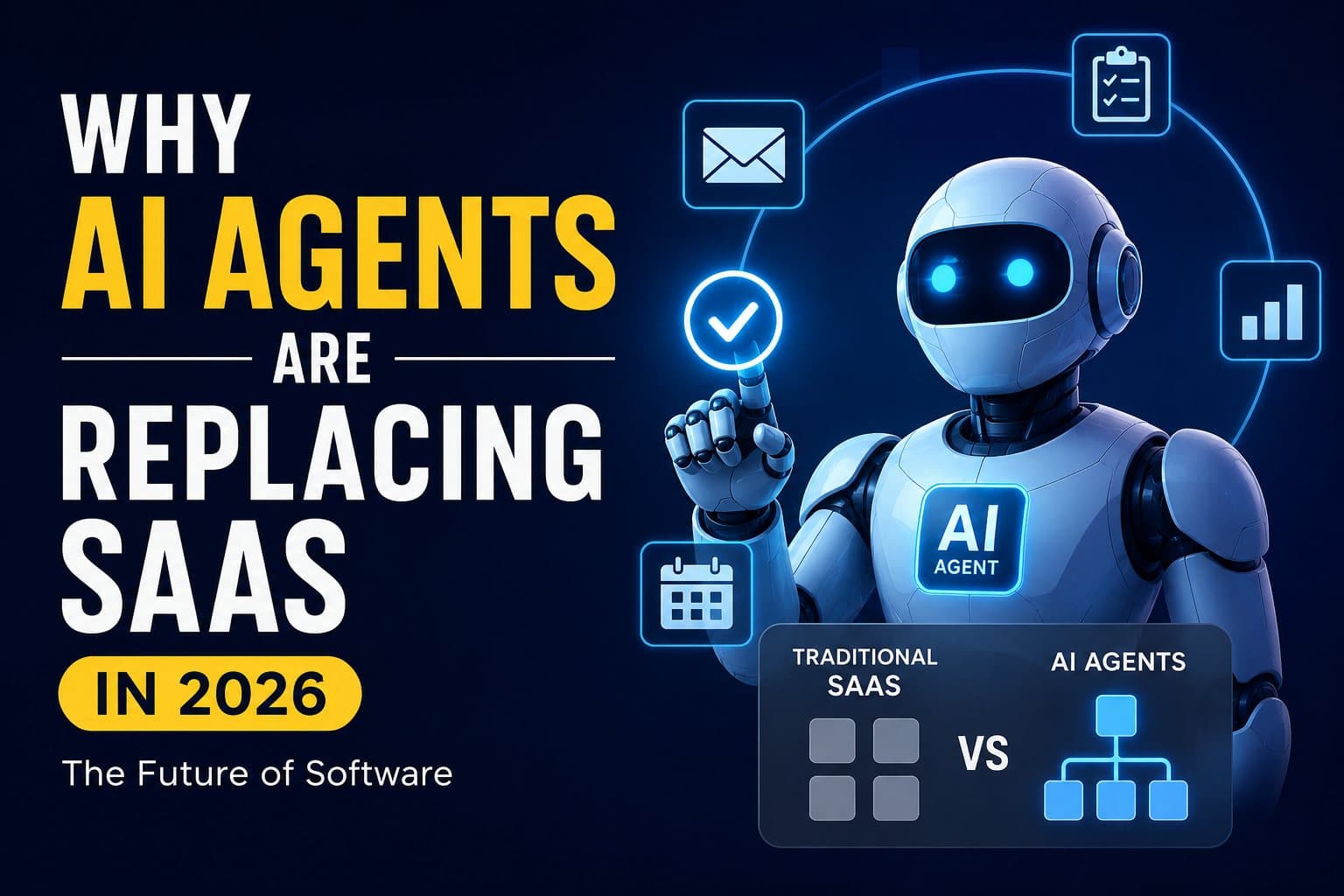

For years, software followed the same formula.
You needed a tool for email.
Another one for CRM.
Another one for analytics.
Another one for customer support.
That was the SaaS world.
But in 2026, something important is changing.
More and more companies are moving from software that people operate manually to AI agents that complete tasks on their behalf. This is not just a trend. It is a major shift in how software is built, bought, and used.
Instead of opening five different dashboards, users now want one thing:
“Just get the job done.”
That simple change is why AI agents are becoming one of the most important ideas in tech today.

What Is an AI Agent?
An AI agent is not just a chatbot.
A chatbot answers questions.
An AI agent takes action.
For example, a chatbot may tell you how to send an email campaign.
An AI agent can research leads, write the email, personalize it, send it, and track the results.
That is the real difference.
An AI agent can:
understand a goal
break it into steps
use tools
make decisions
complete workflows
learn from feedback
In simple words, a chatbot talks.
An AI agent works.
That is why people are calling this shift agentic AI.
Why SaaS Is Under Pressure
Traditional SaaS products usually depend on users doing the work inside the software.
You log in.
You click buttons.
You move data around.
You repeat the same steps every day.
That model worked for a long time.
But now many users want faster results with less effort.
AI agents can connect multiple tasks into one flow. A single agent can handle research, writing, scheduling, reporting, follow-ups, and more.
This changes the value of software.
The old question was:
“What tools do I need?”
The new question is:
“What outcome do I want?”
That is a big shift.
And it is one reason why some traditional SaaS products may slowly lose attention unless they add AI-powered automation.
Why AI Agents Are Growing So Fast
There are a few reasons this trend is happening now.
First, AI models have become much better. They can reason, write, summarize, search, and follow instructions more reliably than before.
Second, businesses want to save time. Every company is looking for ways to reduce repetitive work and cut costs.
Third, users are getting tired of switching between too many tools. People want software that feels simple, intelligent, and useful.
Fourth, AI agents are becoming easier to build. Developers can now connect models with APIs, databases, and workflow tools to create real automation.
So the timing is perfect.
Technology is ready.
Businesses want it.
Users are expecting it.
That is usually how a major shift begins.
What This Means for Startups
For startups, this is both a warning and an opportunity.
The warning is simple: do not build another thin wrapper around a chatbot and expect long-term success.
That kind of product is easy to copy.
The opportunity is much bigger.
The best startup ideas in 2026 will likely focus on solving real problems with AI agents. Not generic AI. Not hype. Real workflows.
For example:
AI agents for customer support teams
AI agents for sales outreach
AI agents for legal research
AI agents for real estate listings
AI agents for content operations
AI agents for finance reporting
AI agents for education and tutoring
The winners will not just say “we use AI.”
They will show clear value.
They will save time, reduce work, and improve results.
That is what customers pay for.
Will SaaS Disappear?
No.
That would be too dramatic.
SaaS is not going to vanish overnight. In fact, many SaaS companies will survive by adding AI agents into their products.
But the interface of software will change.
Instead of always clicking through menus, users may simply describe what they need and let the agent do the rest.
That means the product experience becomes less about dashboards and more about outcomes.
This is similar to how mobile apps changed desktop software. The old version did not fully disappear. It just had to adapt.
The same thing is happening now.
SaaS is not dead.
But SaaS without intelligence may struggle.
The Real Value Shift in Software
In the past, software won by having the best features.
Now software wins by delivering the best workflow.
That means the important things are:
speed
trust
integration
automation
accuracy
ease of use
AI agents can improve all of these if built well.
A good agent does not just produce a result. It helps the user move from idea to action with less friction.
That is why businesses are excited.
It is not about replacing people.
It is about removing boring, repetitive work.
Where AI Agents Are Most Useful
AI agents work best in jobs that are repetitive, structured, and data-heavy.
That includes:
replying to support tickets
generating reports
scheduling meetings
qualifying leads
drafting emails
searching documents
comparing products
organizing content
updating internal systems
In these areas, agents can save a huge amount of time.
But they are not perfect.
They still need guardrails, human review, and clear instructions.
The strongest products will combine AI speed with human control.
That balance matters.
What Users Actually Want
Most users do not care whether a product is called SaaS, AI, or agentic workflow platform.
They care about one thing:
Does it help me get results faster?
That is the whole game.
If a product reduces stress, saves time, and makes work easier, people will use it.
If it is confusing, slow, or full of empty AI hype, they will leave.
This is why the best AI products in 2026 will be simple on the outside and powerful on the inside.
What Smart Founders Should Build Next
If you are building in this space, the best path is not to chase trends blindly.
Build around a real workflow.
A good AI product usually has these traits:
one clear user problem
a specific audience
a measurable time-saving result
strong data or workflow integration
simple onboarding
a reason to keep using it
The strongest startups may look boring at first.
But boring tools that save time often make the most money.
That is the part many founders miss.
Final Thoughts
AI agents are not just another tech buzzword.
They represent a real change in how software works.
For years, software asked people to do more work inside tools.
Now software is starting to do the work for people.
That is a powerful shift.
Traditional SaaS will not disappear, but it will have to evolve quickly. The companies that adapt will survive. The ones that ignore this change may fall behind.
For startups, creators, and product builders, this is one of the biggest opportunities of the decade.
The future of software is not just about tools.
It is about action.
And AI agents are becoming the layer that turns intention into execution.
FAQ
1. What is an AI agent?
An AI agent is a system that can understand a goal, plan steps, use tools, and complete tasks with minimal human help.
2. Are AI agents replacing SaaS completely?
No. SaaS is not disappearing, but many SaaS products will need AI agents to stay competitive.
3. Why are AI agents becoming popular?
They save time, reduce repetitive work, and make software easier to use.
4. What businesses can use AI agents?
Sales, support, marketing, finance, legal, education, real estate, and operations teams can all benefit from AI agents.
5. Are AI agents better than chatbots?
Yes, because chatbots mostly answer questions, while AI agents can take action and complete tasks.
6. Is AI agent technology good for startups?
Yes. Startups can build focused tools that solve real problems with automation and AI workflows.