Income Tax Calculation India 2026: Complete Guide with Examples
What is income tax in India?
Income tax is a direct tax paid to the Government of India on your annual income. It is governed by the Income Tax Act, 1961 and is calculated based on your total income in a financial year from April to March. For FY 2025-26, which corresponds to AY 2026-27, you can generally compare the new tax regime and the old tax regime before deciding which one fits better.
The good news is that once you understand taxable income, slabs, deductions, and cess, the calculation becomes much more manageable. The hardest part is usually not the math. It is knowing which numbers to apply and in what order.
New tax regime slabs 2026 (default)
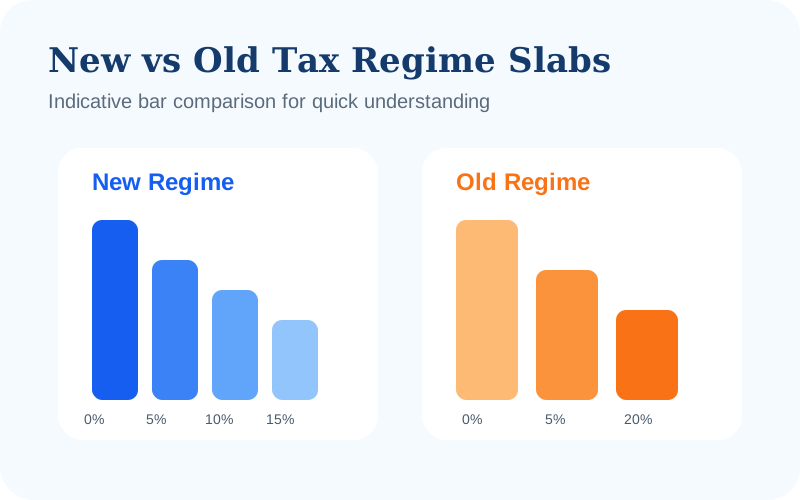
Under the new regime, the slab structure is designed to be simpler, with lower rates across more brackets and fewer deductions. A common quick summary is:
| Income Slab | Tax Rate |
|---|---|
| Up to Rs. 3,00,000 | NIL |
| Rs. 3,00,001 to Rs. 7,00,000 | 5% |
| Rs. 7,00,001 to Rs. 10,00,000 | 10% |
| Rs. 10,00,001 to Rs. 12,00,000 | 15% |
| Rs. 12,00,001 to Rs. 15,00,000 | 20% |
| Above Rs. 15,00,000 | 30% |
Key benefits usually include a standard deduction of Rs. 75,000 for salaried taxpayers, no need to show a large list of investments, and faster comparison between packages. The trade-off is that most older deductions do not apply in the same way.
Old tax regime slabs 2026
The old regime follows a more traditional slab structure and allows a much wider set of deductions and exemptions. A simple summary is:
| Income Slab | Tax Rate |
|---|---|
| Up to Rs. 2,50,000 | NIL |
| Rs. 2,50,001 to Rs. 5,00,000 | 5% |
| Rs. 5,00,001 to Rs. 10,00,000 | 20% |
| Above Rs. 10,00,000 | 30% |
The old regime can still work well for people using deductions such as Section 80C, HRA exemption, LTA, home loan interest, health insurance under Section 80D, and NPS. It usually becomes more attractive when your deduction profile is strong enough to offset the higher headline slab rates.
New vs old tax regime - which is better?
Neither regime is universally better for everyone. The new regime is simpler and often better for people with lower deductions. The old regime can still win when a taxpayer has meaningful 80C investments, HRA benefit, home loan interest, and other eligible exemptions.
| Feature | New Regime | Old Regime |
|---|---|---|
| Tax slabs | Lower rates | Higher rates |
| Deductions | Very few | Many available |
| Best for | Low investments | High investments |
| Simplicity | Simple | Complex |
| Standard deduction | Rs. 75,000 | Rs. 50,000 |
A simple rule many people use is that income below Rs. 7 lakh often leans toward the new regime, while income above Rs. 15 lakh with substantial deductions may still favour the old regime. The safest move is to compare both using a calculator before filing.
Step by step income tax calculation 2026
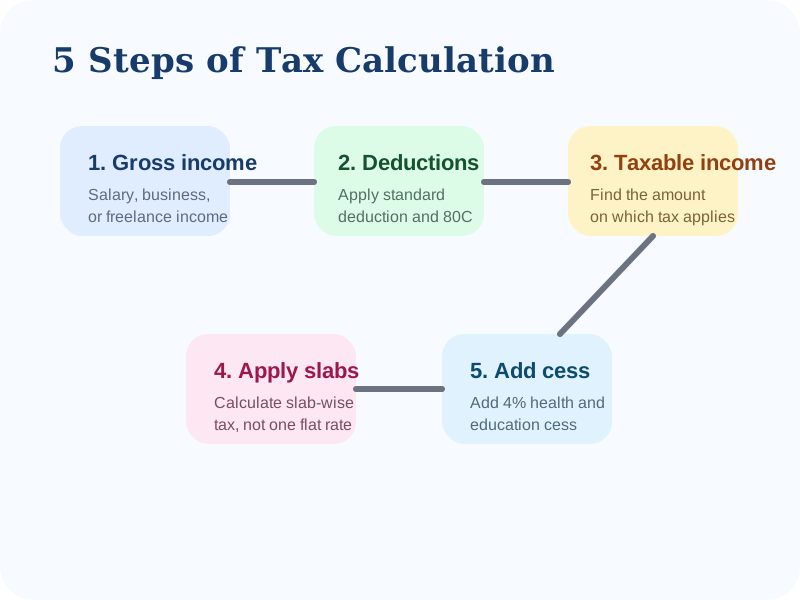
Tax calculation usually follows the same order: start with gross income, subtract eligible deductions, find taxable income, apply the relevant slabs, and then add health and education cess at 4 percent.
Example 1 - Salaried person (new regime)
Rahul has an annual salary of Rs. 10,00,000. Under the new regime, he applies the standard deduction of Rs. 75,000, so taxable income becomes Rs. 9,25,000.
Slab-wise tax: 0 to Rs. 3,00,000 = NIL. Rs. 3,00,001 to Rs. 7,00,000 = Rs. 4,00,000 x 5% = Rs. 20,000. Rs. 7,00,001 to Rs. 9,25,000 = Rs. 2,25,000 x 10% = Rs. 22,500.
Total tax is Rs. 42,500. Add 4% cess of Rs. 1,700 and total tax payable becomes Rs. 44,200. Monthly TDS comes to about Rs. 3,683.
Example 2 - Salaried person (old regime)
Priya earns Rs. 12,00,000 annually and claims Rs. 1,50,000 under 80C, Rs. 1,20,000 as HRA exemption, and Rs. 50,000 standard deduction. Total deductions are Rs. 3,20,000, so taxable income becomes Rs. 8,80,000.
Slab-wise tax: 0 to Rs. 2,50,000 = NIL. Rs. 2,50,001 to Rs. 5,00,000 = Rs. 2,50,000 x 5% = Rs. 12,500. Rs. 5,00,001 to Rs. 8,80,000 = Rs. 3,80,000 x 20% = Rs. 76,000.
Total tax is Rs. 88,500. Add 4% cess of Rs. 3,540 and total payable becomes Rs. 92,040. Monthly TDS comes to about Rs. 7,670.
Important deductions under old regime
Section 80C allows up to Rs. 1,50,000 across items such as PPF, ELSS, life insurance, EPF, NSC, home loan principal, children tuition fees, and tax-saving fixed deposits. Section 80D supports health insurance deduction, and Section 24B covers eligible home loan interest.
Section 80CCD(1B) allows an extra NPS deduction of up to Rs. 50,000 over and above the 80C cap. HRA exemption can also make a major difference for salaried people living on rent. This is why the old regime still matters for people with real deduction planning.
For HRA, the exempt amount is generally the minimum of actual HRA received, 50% of salary in metro cities or 40% in non-metro cities, and rent paid minus 10% of salary.
Income tax for freelancers 2026
Freelancers are generally taxed as self-employed individuals. One common route is presumptive taxation under Section 44ADA for eligible professionals within the threshold. Under this simplified approach, 50% of gross receipts may be treated as income, reducing accounting friction.
For example, if a freelancer earns Rs. 10,00,000 and presumptive income is taken as Rs. 5,00,000, the effective tax burden may be quite low under the new regime. This is one reason freelancers should compare regime choice and filing form carefully instead of assuming salaried logic applies unchanged.
How to pay income tax online
Start by estimating your tax with the inclaw India Tax Estimator. Then visit the official Income Tax e-Filing portal, log in with PAN-based credentials, choose the correct ITR form, and pay the required amount online through net banking, UPI, or card where available.
Salaried individuals often use ITR-1 or ITR-2 depending on their profile, while freelancers and professionals commonly evaluate ITR-3 or ITR-4. The correct form depends on your income structure, capital gains, business income, and presumptive taxation status.
Official PAN and Aadhaar links people often need
Tax filing often spills into identity and compliance tasks. If you need to manage those steps, use the official portals directly instead of random third-party sites.
Official PAN application portal for new PAN applications and PAN correction requests through Protean.
MyAadhaar official portal for Aadhaar download, update status, PVC card orders, and resident services.
Income Tax Department portal for e-filing, PAN-linked tax services, and return-related workflows.
Important income tax dates 2026
| Date | What to do |
|---|---|
| 15 June 2026 | Advance tax 1st installment (15%) |
| 15 Sept 2026 | Advance tax 2nd installment (45%) |
| 15 Dec 2026 | Advance tax 3rd installment (75%) |
| 15 Mar 2027 | Advance tax 4th installment (100%) |
| 31 July 2026 | ITR filing deadline (salaried) |
| 31 Oct 2026 | ITR filing deadline (audit cases) |
These dates matter because delayed payment or late filing can create interest, penalties, or avoidable stress. If your income is uneven or you have freelance receipts, earlier planning is usually better than waiting for deadline month.
Free income tax calculator India 2026
Do not want to calculate everything manually? Use the inclaw India Tax Estimator. Enter your annual income, add deductions, choose old or new regime assumptions, and get instant results.
Conclusion
Calculating income tax in India in 2026 becomes much easier once you understand slabs, deductions, and the order of the calculation. The new regime is simpler and better for many people, while the old regime can still be better for taxpayers with stronger deductions.
Key takeaways are simple: compare both regimes, understand your deductions before filing, remember that income up to around Rs. 7 lakh can be effectively tax free for many under the new regime, and do not miss the filing deadline. For a faster planning view, try the inclaw India Tax Estimator. If you are salaried, the Salary Calculator is also useful when you want to compare CTC, in-hand pay, and likely tax impact together.
Disclaimer: This guide is for educational purposes only. Tax rules can change and individual situations vary, so a CA should review personalised or high-stakes tax decisions.
FAQ
Is income up to Rs. 7 lakh tax free in 2026?
Under the new tax regime, rebate relief and the standard deduction can make income up to Rs. 7 lakh effectively tax free for many salaried taxpayers.
Which is better, new or old tax regime?
For many salaried people with lower deductions, the new regime is simpler and often better. For people with higher deductions such as HRA, 80C, home loan interest, or NPS, the old regime may still save more tax.
What is the last date to file ITR for 2026?
For most salaried individuals, the article uses 31 July 2026 as the filing deadline, while audit cases generally have a later deadline such as 31 October 2026.
Do I need to file ITR if income is below the exemption limit?
You may not be required to file in every case, but many people still do it for loan, visa, and income record purposes.
What is TDS and how is it different from income tax?
TDS is tax deducted in advance by the payer, such as your employer. Income tax is your full annual tax liability, which you reconcile when filing your return.
Related reading
AI Tools
10 Best Free AI Tools for Indians in 2026
A practical roundup of free AI tools Indians can use in 2026 for resumes, legal drafts, salary math, invoices, writing, and more.
Legal Tips
How to Send Legal Notice in India Free
A plain-language guide to legal notices in India, what to include, when to send one, and how inclaw helps with first drafts and explanations.