
What is Claude Fable 5? A beginner’s guide to Anthropic’s biggest new model
What is Claude Fable 5? On June 9, 2026, Anthropic released a model that made the AI world stop and stare. Not because it had a flashy chatbot demo, but because it was built for the kind of work that usually breaks lesser models: long reasoning, agentic tasks, huge documents, and multi-step problem solving. Anthropic now describes Fable 5 as its most capable widely released model for demanding reasoning and long-horizon agentic work, with a 1M-token context window and always-on adaptive thinking. At the same time, Anthropic’s pricing page currently labels Fable 5 as unavailable, so the “big launch” story comes with a real-world access caveat.
What Is Claude Fable 5?
Claude Fable 5 is Anthropic’s newest top-tier Claude model. In plain English, think of it as the version of Claude that is meant to handle the hardest, most annoying, most “please do not lose the thread” tasks. Anthropic says it is the model for the most demanding reasoning and long-horizon agentic work, and the launch materials position it above the everyday Claude models people already know.
If that sounds abstract, here is the simple version: it is the Claude model you would trust with a giant codebase, a messy research project, or a long task that needs to stay coherent from start to finish. Anthropic also says Fable 5 has a 1M-token context window, which means it can hold a very large amount of text, code, or document content in memory during a single request. That matters because the model is less likely to “forget” what it was doing halfway through a big job.
For regular users, what is Claude Fable 5 really asking? It is asking whether this is just “another chatbot” or something bigger. The answer is bigger: it is Anthropic’s flagship model for serious, extended work, not just quick back-and-forth chat.
What Makes Fable 5 Different From Previous Claude Models?
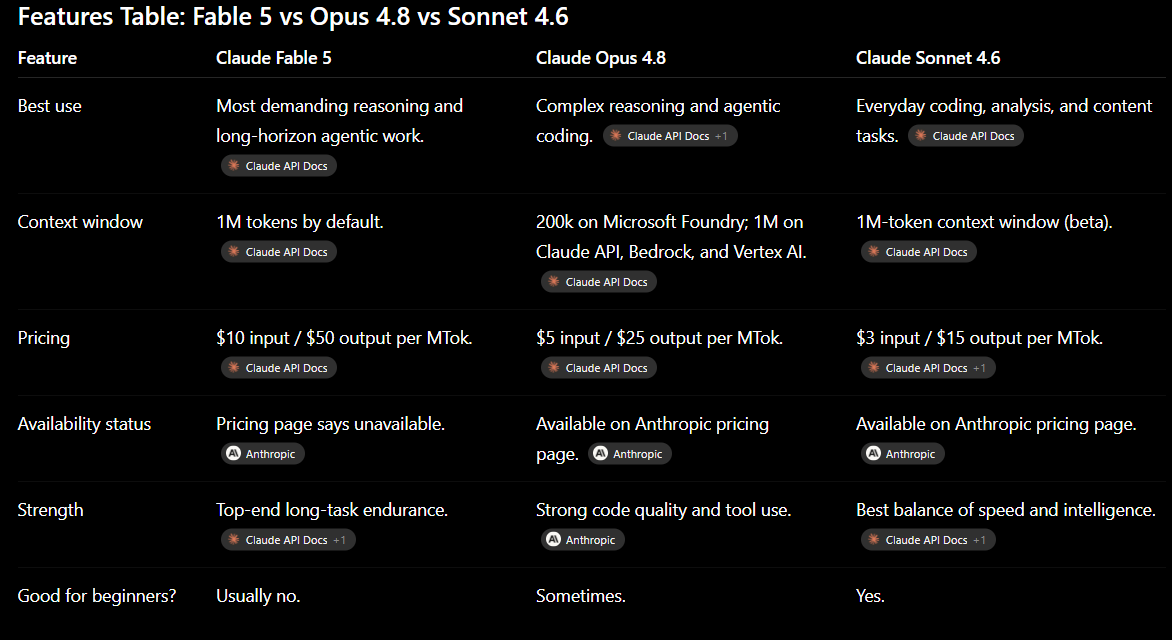
The biggest difference is the work style. Anthropic positions Fable 5 as the model for long-horizon, agentic tasks, while Sonnet 4.6 is described as the best balance of speed and intelligence for everyday tasks, and Opus 4.8 is framed as the strongest Opus-tier model for complex reasoning and agentic coding. So Fable 5 sits at the top end of the “push hard, stay focused, keep going” spectrum.
There is also a safety-and-systems angle. Anthropic’s system card and transparency materials treat Fable 5 as part of a new frontier generation, alongside Mythos 5, with public evaluation work and long-context capabilities that are specifically meant for serious workloads. In practical terms, that means Anthropic is not presenting it as a novelty model; it is presenting it as the model you bring in when quality and endurance matter.
One more useful distinction: Fable 5 is not just “smarter sounding.” It is built to keep working across long tasks with less drift. Anthropic’s docs say it uses adaptive thinking by default, which is meant to help the model spend effort more intelligently across difficult requests. That is the kind of thing most people never notice directly, but they do notice the result: fewer dead ends, fewer shallow answers, and fewer “sorry, I lost track” moments.
What Can You Actually DO With Claude Fable 5?
In real life, Fable 5 is meant for things like deep analysis, long coding sessions, agent workflows, and document-heavy work. Anthropic’s launch and docs repeatedly call out long-horizon reasoning, complex engineering, and multi-agent workflows, and Claude Code also lists Fable 5 among the models it can use. That means Anthropic sees it as a serious developer-and-research model, not just a chat assistant.
If you are a non-technical user, here is the easiest mental model: Fable 5 can help draft, revise, compare, summarize, reason, and refine over a much larger working space than most chatbots. Anthropic’s launch materials mention designs, prototypes, slides, one-pagers, and more in the broader Claude ecosystem, so Fable 5’s real value is that it can support long creative and analytical workflows without losing the plot.
This is where what is Claude Fable 5 becomes practical. It is not “an AI that knows everything.” It is an AI that is built to stay with the job long enough to finish it well. For users, that usually means better continuity across research, coding, and analysis tasks. That is an inference from the long-context and long-horizon design, but it is exactly what Anthropic is optimizing for.
Claude Fable 5 Benchmark Results (what the numbers mean for regular users)
Anthropic says Fable 5 is the first model to break 90% on its core analytics benchmark for complex, long-running analytical tasks, and it also says the model is the highest-scoring model on FrontierBench, Cognition’s frontier coding evaluation. Those are benchmark wins, but the human translation is simpler: the model is very strong at staying coherent across difficult, multi-step work.
Benchmarks matter because they are a rough stress test, not a magic spell. A model that scores well on long-running analytics and frontier coding is more likely to do well when the job is messy, nested, and full of dependencies. For a regular user, that means fewer repeated prompts, better follow-through, and a better chance that a long answer or code task will remain internally consistent. That’s the practical meaning of the numbers.
The benchmark story also fits the product design. Anthropic’s model docs describe Fable 5 as the most capable widely released model and give it a 1M-token context window. Put those together and the message is pretty clear: this model is meant to do big, sustained work, not just quick chat.
How to Access Claude Fable 5 in India
India is on Anthropic’s supported list for Claude.ai access, and India is also listed in the supported regions for the Claude API. So the country itself is not the blocker; Anthropic does support Claude in India. The catch is that Anthropic’s pricing page currently says Fable 5 is unavailable, even though the docs still describe it as the most capable widely released model. That means access may vary by surface or account, and it may not appear as a selectable model right now.
The practical way to check is simple: open Claude.ai, sign in, and look at the model picker. If you are using the API or Claude Console, check the current model list in the docs and pricing pages before building anything around it. If Fable 5 is not visible, do not assume you are missing a hidden setting; Anthropic’s own pricing page currently calls it unavailable.
So, what is Claude Fable 5 in India right now? It is a supported model name in Anthropic’s ecosystem, but not a guaranteed “click and use” option for every user at every moment. That is the honest answer based on Anthropic’s current docs.
Is Claude Fable 5 Free?
No, not in the usual sense. Anthropic’s pricing page shows Claude Free, Pro, Max, Team, and Enterprise plans, but Fable 5 itself is listed on the API pricing table and marked unavailable on the plan page. The API pricing shown by Anthropic is $10 per million input tokens and $50 per million output tokens for Fable 5, which is firmly in paid territory.
For individual users, Anthropic’s help center says Pro is $20/month, Max 5x is $100/month, and Max 20x is $200/month, but those are Claude plan tiers rather than a special “free Fable 5” offer. So if you hear someone say Fable 5 is free, that is not what Anthropic’s current pricing pages show.
Claude Fable 5 vs Claude Sonnet 4.6 — Which Should You Use?
If you are a beginner, Sonnet 4.6 is probably the better default. Anthropic describes Sonnet 4.6 as the best combination of speed and intelligence, and says it is ideal for everyday coding, analysis, and content tasks. It also adds improved agentic search capabilities and free code execution when used with web search or web fetch.
Use Fable 5 when the task is truly heavy: long reasoning, complex multi-step analysis, or advanced agentic workflows. Use Sonnet 4.6 when you want something fast, reliable, and easier to live with day to day. That is the simplest way to think about the split.
There is also a price-angle difference. Sonnet 4.6 is listed at $3 per million input tokens and $15 per million output tokens, while Fable 5 is $10 and $50 respectively. So unless you truly need the top-end model, Sonnet 4.6 is the easier choice for most users and most teams.
FAQ
Is Claude Fable 5 the same as Claude Opus 4.8?
No. Anthropic presents Fable 5 as a newer, top-tier model for the most demanding reasoning and long-horizon work, while Opus 4.8 is the strongest Opus-tier model for complex reasoning and agentic coding.
Is Claude Fable 5 available in India?
India is a supported country for Claude.ai and a supported region for the Claude API, but Anthropic’s pricing page currently marks Fable 5 as unavailable. So access in India may be limited or surface-dependent.
What makes Fable 5 special?
Its long-context design, adaptive thinking, and benchmark performance on long-running analytics and frontier coding are the big headline features. That combination is what makes it feel more like a serious work model than a general chat model.
Can beginners use Fable 5?
Technically yes, but Sonnet 4.6 is a much easier starting point. Anthropic itself frames Sonnet 4.6 as the model for everyday coding, analysis, and content tasks.
Should I wait for Fable 5 if I already use Claude?
Only if your work genuinely needs the top-end reasoning and long-horizon behavior. For most people, Sonnet 4.6 and Opus 4.8 are already extremely strong and more practical to use every day.
Conclusion: Should you upgrade to Fable 5?
If you are just trying to understand what is Claude Fable 5, the simplest answer is this: it is Anthropic’s flagship model for big, difficult, long-running tasks. It is impressive because it is built for endurance, not just speed. The benchmarks, context window, and long-horizon positioning all point in the same direction.
But should you upgrade to it? For most beginners, probably not yet. Sonnet 4.6 is the better everyday choice, and Anthropic’s own docs frame it that way. Fable 5 is the model you watch closely, not necessarily the one you need first. And if you are in India, the access story matters even more, because Anthropic currently lists Fable 5 as unavailable on pricing while still supporting Claude access in India.