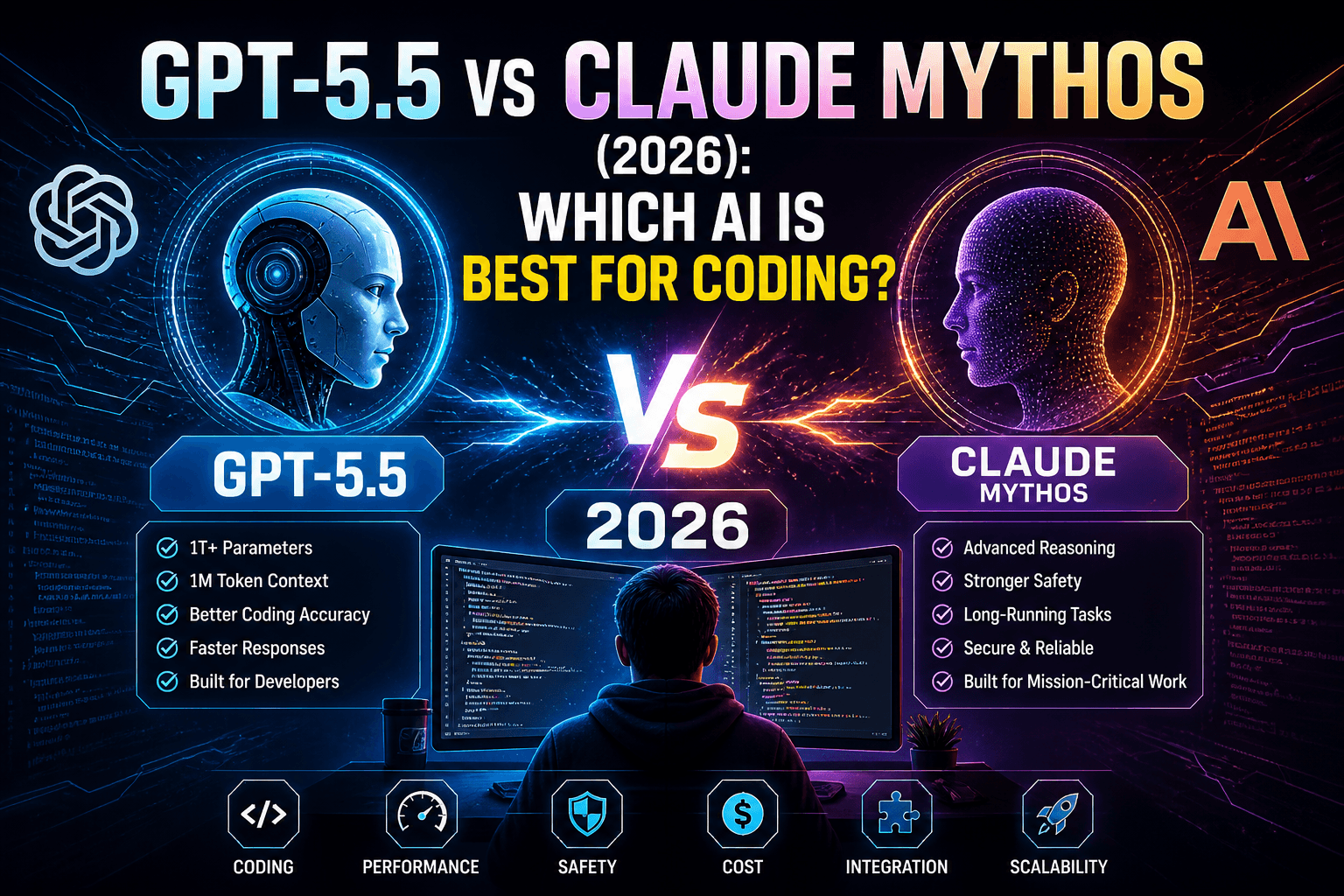
GPT-5.5 vs Claude Mythos (2026): Which AI is Best for Coding? explained with practical Indian context, clear steps, and tools you can use on INCLAW today.
The AI race in 2026 has two clear frontrunners for developers: OpenAI's GPT-5.5 and Anthropic's Claude Mythos Preview. If you're a frontend or UI developer trying to decide which model to use for your next project, this is the only guide you need. We break down benchmarks, costs, real coding performance, and give you ready-to-use prompts — all backed by official data from OpenAI's launch blog (https://openai.com/blog/introducing-gpt-5-5/) and Anthropic's official model card (https://docs.aws.amazon.com/bedrock/latest/userguide/model-card-anthropic-claude-mythos-preview.html).
Whether you're building React components, debugging CSS layouts, or scaling a full design system — this GPT-5.5 vs Claude Mythos comparison will save you hours of research.
What Is GPT-5.5? OpenAI's Most Powerful Coding Model
Ad space
GPT-5.5 is OpenAI's latest large language model, released in April 2026. It's a 1 trillion+ parameter model with a 1 million token context window — large enough to process an entire codebase in a single prompt. According to OpenAI's official announcement (https://openai.com/blog/introducing-gpt-5-5/), GPT-5.5 delivers the same per-token speed as GPT-5.4 but is dramatically smarter, more accurate, and uses far fewer tokens per task.
Key highlights of GPT-5.5:
Same latency as GPT-5.4 — no speed sacrifice for higher intelligence
Approximately 72% fewer output tokens than Claude Opus 4.7 on equivalent tasks
Strongest safety guardrails to date, vetted by external red-teamers
Best-in-class coding — handles messy multi-step tasks autonomously
Available via API and ChatGPT for general developers right now
GPT-5.5 is also available in a GPT-5.5 Pro variant for mission-critical applications. You can explore AI tools you can use today on our Inclaw AI Tools Catalog at https://inclaw.me/tools.

What Is Anthropic Claude Mythos Preview?
Claude Mythos Preview is Anthropic's most advanced — and most restricted — AI model. Launched on April 7, 2026, it is described by Anthropic as "a new class of intelligence built for ambitious projects focusing on cybersecurity, autonomous coding, and long-running agents."
However, Mythos is not publicly available. Access is limited to a small group of trusted partners, government agencies, and security researchers — making it a specialized research asset rather than a developer tool you can use today. The full model card is available on Amazon Bedrock's documentation at https://docs.aws.amazon.com/bedrock/latest/userguide/model-card-anthropic-claude-mythos-preview.html.
Key facts about Claude Mythos:
Gated access only — not available to the public
1 million token context window, same as GPT-5.5
Optimized for cybersecurity, exploit detection, and agentic tasks
Scores 82.0% on Terminal-Bench 2.0 (vs GPT-5.5's 82.7%)
No public pricing — preview-only model
For everyday frontend development, Claude Mythos is simply not an accessible option. The more practical Anthropic model is Claude Opus 4.7 (https://www.anthropic.com/claude), though it scores considerably lower on coding benchmarks — 69.4% on Terminal-Bench 2.0.
Benchmark Comparison: GPT-5.5 vs Claude Mythos
The most important independent benchmark is Terminal-Bench 2.0 — a Stanford/Harbor suite of 89 real-world coding and security tasks. The full benchmark repository is available at https://github.com/harborframework/terminal-bench and the academic paper at https://arxiv.org/abs/2403.17375.
Here is how the top models compare:
GPT-5.5 — Terminal-Bench 2.0: 82.7% — Expert-SWE Coding: 73.1% — Token Efficiency: Best (72% fewer tokens) — Availability: Public API
Claude Mythos Preview — Terminal-Bench 2.0: 82.0% — Expert-SWE Coding: Not published — Token Efficiency: Unknown — Availability: Gated only
Claude Opus 4.7 — Terminal-Bench 2.0: 69.4% — Availability: Public
GPT-5.4 (Previous) — Terminal-Bench 2.0: 75.1% — Expert-SWE Coding: 68.5% — Availability: Public
Google Gemini 3.1 Pro — Terminal-Bench 2.0: ~68.5% — Expert-SWE Coding: 75.9% — Availability: Public
Sources: VentureBeat analysis (https://venturebeat.com/ai/openais-gpt-5-5-is-here-and-its-no-potato-narrowly-beats-anthropics-claude-mythos-preview-on-terminal-bench-2-0/) and OpenAI's official blog (https://openai.com/blog/introducing-gpt-5-5/).
Key takeaway: GPT-5.5 narrowly beats Claude Mythos (82.7% vs 82.0%) on the most credible real-world coding benchmark available. It also shows a massive 7.6% jump over its predecessor GPT-5.4, confirming this is a genuine generational leap.
Cost and Token Efficiency: What Developers Actually Pay
Current pricing from OpenAI's pricing page (https://openai.com/pricing):
GPT-5.5 — Input: $5.00 per 1K tokens — Output: $30.00 per 1K tokens — Effective cost: Lower per task due to token efficiency
GPT-5.5 Pro — Input: $30.00 per 1K tokens — Output: $180.00 per 1K tokens
GPT-5.4 (Previous) — Input: $2.50 per 1K tokens — Output: $15.00 per 1K tokens — Effective cost: Higher per task
Claude Mythos Preview — Pricing not publicly available
Although GPT-5.5's rate is double GPT-5.4, it requires up to 72% fewer output tokens per task — meaning real-world costs are often lower for complex, multi-step work. For a typical frontend task such as generating a 200-token React component with a 100-token prompt, GPT-5.5 costs approximately $0.03 per generation.
Developer reports consistently show that productivity gains — fewer prompt iterations, higher first-pass accuracy — more than justify the cost. One frontend engineer on Reddit r/codex reported that GPT-5.5 needed about 40% fewer steps to build a complete UI app compared to GPT-5.4.
Frontend and UI Development: Where GPT-5.5 Excels
For web and UI developers, GPT-5.5 delivers major improvements in four key areas:
UI Code Generation from Descriptions
GPT-5.5 can generate complete, responsive HTML/CSS/React components from a brief text description — getting it right the first time far more reliably than previous models. It understands design intent, produces accessible markup, and creates personalized components without extra prompting. According to OpenAI's frontend coding blog (https://openai.com/blog/frontend-coding-with-gpt-5/), developers can go from wireframe description to production-ready component in a single pass.
Full-Codebase Refactoring
With a 1 million token context window, GPT-5.5 can analyze and refactor an entire project at once — migrating design patterns, standardizing component libraries, or updating button styles across multiple files simultaneously. This level of conceptual clarity across a codebase is new for large language models.
Debugging and Accessibility Audits
Ask GPT-5.5 to find CSS grid bugs, missing ARIA labels, semantic HTML issues, or JavaScript logic errors — and it returns precise, actionable corrections. It can also write Jest unit tests, Cypress end-to-end tests, and Storybook stories automatically.
Iterative Design-to-Code Workflows
GPT-5.5 handles multi-step instruction chains without losing context. Give it a wireframe description, ask for a responsive layout, then request ARIA label additions — all in sequence — and it executes each step correctly without contradicting previous changes. For more on AI-powered development workflows, see our guide at https://inclaw.me/blog/ai-revolution-2026.
5 Ready-to-Use GPT-5.5 Prompts for Frontend Developers
Use these prompts directly in the OpenAI API (https://platform.openai.com/) or ChatGPT with GPT-5.5 selected:
Prompt 1 — Generate a React Navigation Bar Create a responsive React functional component for a navigation bar. Include: brand logo on the left, collapsible hamburger menu on mobile, and 4 nav links on the right. Use Tailwind CSS. Add proper ARIA labels for accessibility. Export as NavBar component.
Prompt 2 — Fix a CSS Grid Bug This CSS grid layout breaks on mobile screens under 768px — columns overflow instead of stacking. Here is my CSS: [paste your CSS]. Identify the bug, explain why it happens, and provide the corrected CSS with comments.
Prompt 3 — Refactor to a Design System Component Refactor these scattered button styles into a single reusable Button React component with variants: primary, secondary, danger, and ghost. Use TypeScript and Tailwind CSS. Include size props (sm, md, lg) and disabled state styling. Show the component and 3 usage examples.
Prompt 4 — Accessibility Audit Review this HTML snippet for accessibility issues: [paste HTML]. Check for: missing alt attributes, ARIA roles, semantic HTML usage, keyboard navigation support, and WCAG 2.2 AA compliance. List each issue with the specific fix.
Prompt 5 — Generate a Features Section Generate a 3-column features section in HTML and Tailwind CSS. Each column has: an SVG icon placeholder, a bold title, and a 2-sentence description. The layout should stack to 1 column on mobile and 2 on tablet. Include hover animations on each card.
Pro tip: Always specify your exact tech stack (for example, React 19, Next.js 15, Tailwind CSS v4) in every prompt. GPT-5.5 uses this context to generate version-accurate, compatible code. Explore more free AI tools for developers at https://inclaw.me/tools.
Hallucination Rates and Safety
GPT-5.5 includes OpenAI's strongest safety guardrails to date, verified by external security partners and red-teamers. It is specifically engineered to handle messy, multi-part tasks autonomously — where GPT-5.4 would hallucinate or lose track of instructions mid-workflow. Exact hallucination rates are not publicly published, but real-world developer reports confirm a notable improvement in first-pass accuracy.
Claude Mythos is restricted precisely because it can generate potent security exploits — which is why Anthropic limits its access. Its safety profile for general use is largely unknown since it is not publicly deployed.
Best practice for both models: always validate AI-generated code with linting tools, unit tests, and real browser testing before shipping to production. Use AI output as a smart first draft, not a final answer. For a roundup of tools to help validate your workflow, see our guide at https://inclaw.me/blog/7-best-free-ai-tools-job-hunting-2026.
Final Verdict: GPT-5.5 vs Claude Mythos — Which Should You Use?
Choose GPT-5.5 if you: build React, Vue, or Angular frontends; need reliable production-ready code generation; want to refactor large codebases; need public API access right now; value token efficiency and lower per-task costs; or work on multi-step design-to-code workflows.
Claude Mythos is only relevant if you: work in government or defense cybersecurity; have been granted gated research access; or need specialized exploit detection. It is simply not applicable for general frontend development.
Bottom line: For frontend and UI developers in 2026, GPT-5.5 is the clear practical winner. It outperforms Claude Mythos on Terminal-Bench 2.0, is publicly accessible via the OpenAI API, requires significantly fewer tokens per task, and is purpose-built for iterative coding workflows that frontend development demands. Claude Mythos, while impressive, is not available to most developers.
You can start using GPT-5.5 today via the OpenAI API documentation at https://platform.openai.com/docs/models or through ChatGPT Pro at https://chat.openai.com/. For more comparisons and AI tool reviews, bookmark our Inclaw AI Tools Catalog at https://inclaw.me/tools.
Frequently Asked Questions
Is GPT-5.5 better than Claude Mythos for coding? Yes. On Terminal-Bench 2.0, GPT-5.5 scores 82.7% vs Claude Mythos's 82.0%. More importantly, GPT-5.5 is publicly available while Claude Mythos is gated. For frontend developers, GPT-5.5 is the practical and more powerful choice.
What is Claude Mythos used for? Claude Mythos is Anthropic's security-focused AI model designed for cybersecurity, autonomous coding agents, and long-running tasks. It is restricted to trusted partners and government agencies — not available for general developer use as of April 2026.
How much does GPT-5.5 cost? GPT-5.5 costs $5.00 per 1,000 input tokens and $30.00 per 1,000 output tokens. GPT-5.5 Pro costs $30 and $180 respectively. While the rate is higher than GPT-5.4, GPT-5.5 uses up to 72% fewer tokens per task, making real-world costs often lower.
What is Terminal-Bench 2.0? Terminal-Bench 2.0 is an independent benchmark developed by Stanford/Harbor consisting of 89 real-world coding and security tasks. It is widely used to objectively measure AI model performance on practical developer tasks. See the Terminal-Bench GitHub repo at https://github.com/harborframework/terminal-bench.
Can I use GPT-5.5 for free? GPT-5.5 is available via paid ChatGPT Pro and the OpenAI API. There is no dedicated free tier, but new API accounts receive limited free credits to get started. Check our guide to free AI tools at https://inclaw.me/blog/7-best-free-ai-tools-job-hunting-2026 for budget-friendly alternatives.
Sources and Further Reading
OpenAI — Introducing GPT-5.5: https://openai.com/blog/introducing-gpt-5-5/
Anthropic / AWS — Claude Mythos Preview Model Card: https://docs.aws.amazon.com/bedrock/latest/userguide/model-card-anthropic-claude-mythos-preview.html
VentureBeat — GPT-5.5 vs Claude Mythos Analysis: https://venturebeat.com/ai/openais-gpt-5-5-is-here-and-its-no-potato-narrowly-beats-anthropics-claude-mythos-preview-on-terminal-bench-2-0/
OpenAI — Frontend Coding with GPT-5: https://openai.com/blog/frontend-coding-with-gpt-5/
Terminal-Bench 2.0 GitHub Repository: https://github.com/harborframework/terminal-bench
Terminal-Bench Academic Paper: https://arxiv.org/abs/2403.17375
OpenAI Pricing Page: https://openai.com/pricing
Anthropic — Claude Model Overview: https://www.anthropic.com/claudehttps://inclaw.me/tools
🔗 Internal Links
🔗 External Authority Links