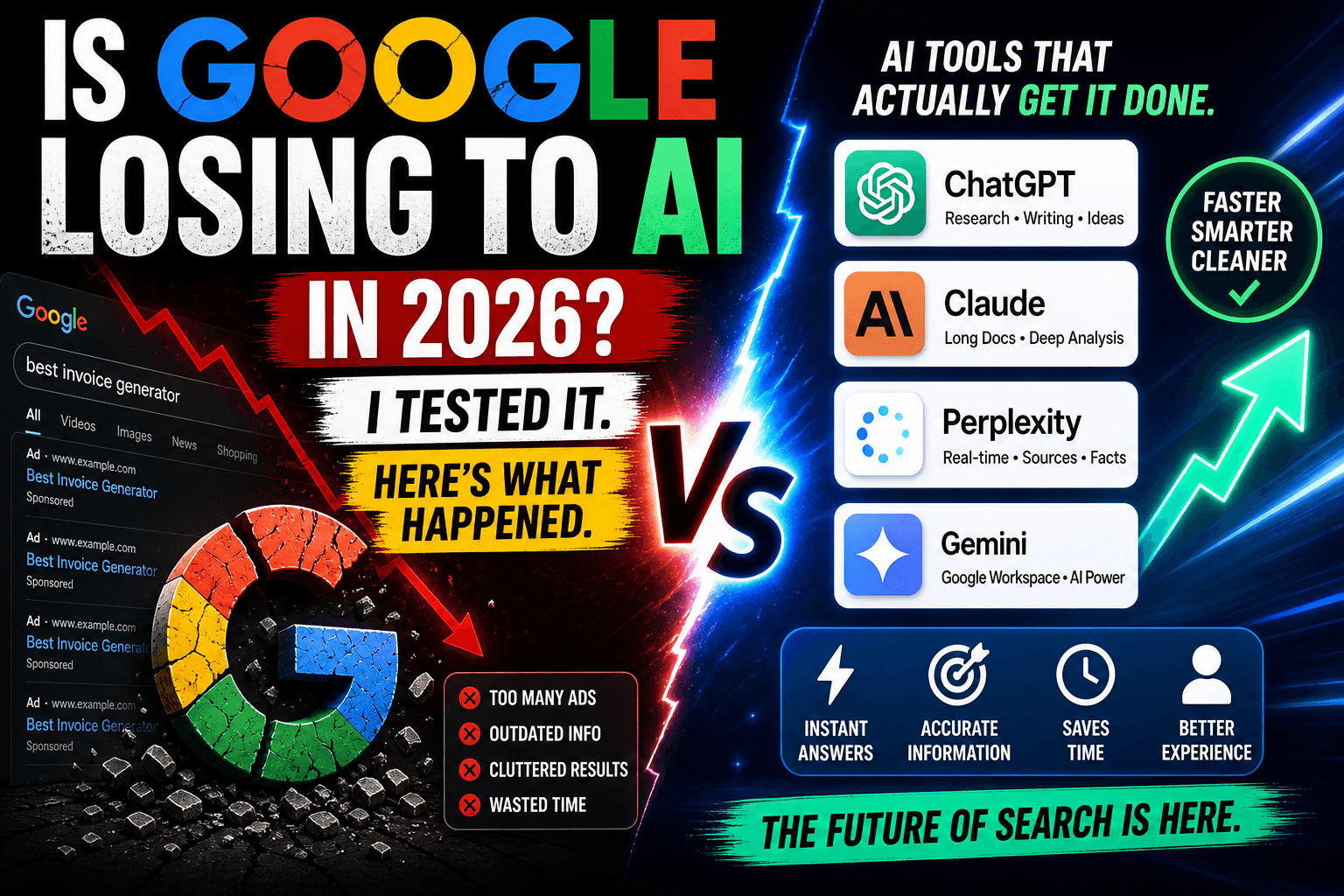
Is Google Losing to AI in 2026? I Tested It — Here’s What Actually HappenedQuick Answer
AI tools like ChatGPT, Perplexity, Claude, and Gemini are changing how people search in 2026 because they give direct answers instead of making users click through multiple pages. Google is still powerful, especially for local search, shopping, and discovery, but for many informational queries, AI feels faster, cleaner, and more useful.
Introduction: The Search Habit That Changed
I used Google maybe twice last week. And both times, I closed the tab frustrated.
That sounds dramatic, but a lot of people understand exactly what that feels like now. You type a simple question into Google, and suddenly you are dodging ads, pop-ups, cookie banners, listicles, affiliate pages, and articles that look like they were written for a search bot instead of a human being.
Ad space
That is the real reason this shift matters. It is not just about technology. It is about how annoying the internet has become.
More and more users are quietly trying something different. Instead of opening a search engine first, they are opening an AI tool and asking the question directly. No scrolling through ten blue links. No opening six tabs. No guessing which article is actually useful.
That change sounds small, but it is huge.
If you run a blog, a business, or even just use the internet every day, you need to understand what is happening right now. The way people find information is changing, and the old rules are getting weaker by the month.
This article is my honest breakdown of the shift: what changed, why people are switching, which tools are replacing Google in daily life, and what website owners should do next.
Why I Started Questioning Google
It started with a simple search: best free invoice generator for freelancers in India.
Google gave me the usual mess. A few ads at the top. A handful of list-style articles. A website with a giant pop-up that blocked the page. Another one that autoplayed a video ad before I could even read the headline.
I spent way too long clicking around, jumping back and forth, and trying to find a straightforward answer.
Then I asked an AI tool the same question.
In seconds, I got a clean answer: a list of options, short explanations, pros and cons, and a recommendation that actually matched the situation.
That was the moment I realized the real difference.
Google gave me access to information.
AI gave me the answer.
And for many searches, that is the entire game.
What Is Actually Happening to Google Search?
Let’s be fair: Google is not dead.
It is still one of the most important products on the internet. It still powers search at an enormous scale, and for a lot of things, it still works very well.
But the old dominance is not as safe as it used to be.
People are using AI tools to ask the kind of questions they used to send to Google. Instead of opening search results and piecing together an answer from several websites, users now expect one clear response that gets them moving faster.
That change matters because search behavior drives the entire web. If people spend less time clicking into websites, then websites get less traffic. If websites get less traffic, then the old SEO playbook becomes less reliable. If the old playbook gets weaker, content creators and businesses have to rethink how they publish, structure, and distribute information.
That is the shift.
It is not about one company winning and another company losing. It is about a new user habit becoming normal.
And once habits change, the web changes with them.
Why AI Search Feels Better to So Many People
There are a few reasons AI tools feel so refreshing compared with traditional search.
1. They answer the question directly
When you ask a good AI tool a question, you are usually not given a pile of links. You are given a summary, an explanation, and often some kind of next step.
That is a much smoother experience than manually opening five pages and figuring out which one is worth your time.
2. They reduce decision fatigue
A search results page can be overwhelming. You are not just looking for information. You are also deciding which source to trust, which article is current, which page is overly promotional, and which result is trying to trap you in an affiliate funnel.
AI reduces that mental friction.
3. They feel conversational
Search is a query box. AI feels like a conversation.
That sounds minor, but it changes everything. Most people do not want a list of possibilities when they are tired, busy, or uncertain. They want help thinking.
4. They are faster for many tasks
If you know what you are looking for, AI can be much faster. A short explanation, a summarized comparison, a draft, a checklist, or a plan can often be produced in one shot.
That speed is addictive.
The AI Tools Replacing Google in Daily Use
Different tools do different jobs. That is the part many people miss.
The smartest approach in 2026 is not to pick one winner. It is to know which tool is best for which task.
ChatGPT — Best for research, writing, brainstorming, and quick explanations
ChatGPT is the tool most people recognize first. It is a strong all-around option when you want to think through something, learn a topic, outline a project, draft text, or explore ideas.
What it does well:
turns messy questions into clear answers
helps with writing and editing
explains topics in plain language
supports brainstorming and structured thinking
Where it is not perfect:
recent information may need verification
it can sound confident even when it is wrong
for live updates, a source-based search tool is usually better
Best use case:
learning
summarizing
writing help
ideation
Link: ChatGPT

Claude — Best for long documents and careful thinking
Claude is often the tool people reach for when they want nuance. It handles long context well, which makes it useful for reading articles, reports, contracts, strategy notes, or any long-form content that needs deep analysis.
What it does well:
reads long documents smoothly
follows detailed instructions well
helps with careful writing and analysis
handles nuanced prompts without drifting as much
Where it is not perfect:
not always the best choice for quick current facts
can still be wrong on recent updates
Best use case:
long documents
careful summaries
structured analysis
writing that needs a more thoughtful voice
Link: Claude
Perplexity — Best for live search with sources
Perplexity is the closest thing to a Google replacement for people who want current information and citations.
It searches the web, pulls together an answer, and attaches sources so you can check the claims. That is a big reason it feels trustworthy for research-heavy questions.
What it does well:
current events
product comparisons
source-backed answers
fast research
Where it is not perfect:
still depends on source quality
not every answer is equally strong
Best use case:
fact-checking
news
pricing
research with citations
Link: Perplexity
Gemini — Best for Google ecosystem users
Gemini fits naturally if you already use Google Docs, Gmail, and Google Drive. It is useful for people who want AI inside the tools they already live in.
What it does well:
integrates into Google’s ecosystem
works well with images and documents
helps people who do not want to switch platforms
Where it is not perfect:
best value depends on your Google workflow
not everyone wants AI inside every app
Best use case:
Google Workspace users
document and image analysis
mixed content tasks
Link: Gemini
inclaw.me free tools — Best for specific business tasks
This part matters a lot for business owners and freelancers.
AI chatbots are useful, but they are not always the fastest way to finish a practical job.
If you need an invoice, a resume, a business name, or another structured output, a dedicated tool often beats a general chatbot because it is faster, cleaner, and already formatted for the task.
That is where inclaw.me can fit in nicely.
Instead of prompting a chatbot, editing the result, checking formatting, and cleaning up the output, you can use a purpose-built tool and get the job done in less time.
Best use case:
invoice generation
resume building
business name ideas
practical workflow tools
Link: inclaw.me free tools
Google Is Not Dead — It Is Just Being Used Differently
This is the part people keep misunderstanding.
Google is not disappearing. It is still extremely useful in several areas, and it still has strengths that AI tools cannot fully replace.
Google is still better for local search
If you want a restaurant nearby, opening hours, directions, reviews, map locations, or a local business, Google is still excellent.
That is because local search is not just about answers. It is about places, distance, timing, navigation, and live business information.
Google is still strong for discovery
Sometimes you do not know exactly what you are looking for. You want to browse, compare, or stumble onto something unexpected.
Google is still good at that.
Google is still useful for shopping research
When you are comparing products, looking for official retailers, or trying to find multiple sources, traditional search still has value.
So the honest answer is not “Google lost.”
The honest answer is:
Google is no longer the only default starting point.
That is the real shift.
What This Means for Bloggers and Website Owners
This is the section that matters most if you want traffic.
The old playbook used to be simple:
choose a keyword
write a long article
rank on Google
collect traffic
That still works sometimes.
But it is no longer enough by itself.
Why? Because users are not only searching with Google anymore. They are also using AI search tools. They are asking questions in chat interfaces. They are reading summaries instead of opening ten websites. They are expecting answers faster than before.
That means your content has to do more than target a keyword.
It has to be:
useful
clear
trustworthy
structured
easy to summarize
In other words, your content has to deserve attention.
That is good news, even if it sounds hard.
Thin content is getting punished by the market. Low-value articles that exist only to catch search traffic are losing their edge. Content that genuinely helps people is becoming more valuable.
That is the opportunity.
If your blog is actually useful, it can win in both search and AI-driven discovery.
SEO Is Changing Into AEO
AEO means Answer Engine Optimization.
That is the new reality.
Instead of writing only for search engines, you are now also writing for systems that summarize, extract, and quote your content.
That means your structure matters more than ever.
What AEO-friendly content looks like
clear headings
direct answers near the top
short explanatory paragraphs
useful examples
lists and comparisons
definitions that can be quoted easily
facts stated cleanly and plainly
What weak AEO content looks like
vague intro paragraphs that never answer anything
keyword stuffing
fluffy filler text
wall-of-text formatting
hidden points buried too deep
If you want AI tools to cite or summarize your blog, the content has to be easy to understand.
That is not a limitation. It is a filter.
And it favors good writers.
A Practical Comparison: Google vs AI Search
Here is the simplest way to think about it.
FeatureGoogleAI ToolsBest forlocal search, discovery, shoppingdirect answers, explanations, summariesUser efforthigherlowerResult stylelinks and snippetssynthesized responseGood for researchyes, but with more clickingyes, often fasterGood for current factsyesdepends on toolGood for learningdecentoften betterGood for browsingstrongweaker
This is why the shift feels so visible to users.
Google is a map.
AI is a guide.
Both are useful, but they are not the same thing.
My Honest Workflow in 2026
This is how I would actually use the tools if I were trying to be efficient.
Use Google for:
restaurants
maps
directions
local services
shopping comparison
discovering official sources
Use ChatGPT for:
brainstorming
drafting
learning
simplification
quick idea generation
Use Claude for:
long documents
detailed writing
careful analysis
structured thinking
Use Perplexity for:
current information
research with citations
product comparisons
news and live facts
Use inclaw.me tools for:
invoices
resumes
practical business tasks
simple utility workflows
That workflow is not flashy, but it is effective.
And the winner is not one tool.
The winner is the person who knows which tool to use at which moment.
What Makes a Blog Actually Rank in This New Era
If you want long-term traffic, you need more than a topic.
You need a content system.
1. Start with a search intent that people actually care about
Good topics include:
is Google dying in 2026
ChatGPT vs Google search
best AI search tools
AI replacing Google search
future of search engines
These are direct, high-interest queries.
2. Give the reader a fast answer first
Do not make people wait.
Put a short summary near the top. That helps humans, and it helps AI systems too.
3. Expand with real examples
People trust examples more than vague opinions.
Show how the behavior changed in real use.
4. Include comparisons
Comparison sections are very shareable and very skimmable.
5. Add useful links
Internal links help your site.
External links help your credibility.
6. End with action
Do not just leave readers with theory. Tell them what to do next.
Why the Future of Search Is Probably Hybrid
A lot of people talk about AI like it will completely replace search.
That is probably too simplistic.
The more realistic future is hybrid search.
That means people will use:
Google for maps and discovery
AI for direct answers and explanations
specialized tools for specific tasks
source-based search when they need verification
That is not a smaller internet.
It is a more segmented internet.
And the people who adapt early will have the advantage.
Why This Shift Matters for Business Owners
If you sell products, run a service, or publish content, this matters in three major ways.
1. Your traffic sources will diversify
You cannot rely on one channel forever.
2. Your content needs to answer better
Not just rank better.
Answer better.
3. Your brand matters more
When people trust your name, they search for you directly. That is harder to replace than random keyword traffic.
That is why building a real brand is becoming more valuable than chasing a single article.
How to Make the Switch Without Overwhelm
You do not need to change your whole internet routine in one day.
Start small.
Step 1: Pick one task you do often
Maybe research, writing, summaries, or quick business tasks.
Step 2: Try an AI tool for one week
Use ChatGPT, Claude, or Perplexity depending on the job.
Step 3: Notice the difference
Ask yourself:
Was it faster?
Was it easier?
Did I trust it?
Did I still need Google afterward?
Step 4: Build a personal workflow
Over time, you will know exactly which tool to open first.
That is the real win.
A Note for People Who Still Trust Google Most
That is fine.
You do not need to become an AI-only user to benefit from the change.
The point is not loyalty.
The point is usefulness.
If Google solves the problem faster, use Google.
If AI solves the problem faster, use AI.
If a dedicated tool solves the problem best, use the tool.
That mindset is what makes you efficient.
What to Put on Your Blog Page to Make It Stronger
If you publish this article, do not stop at the text.
Add these elements to make it perform better:
1. A strong featured image
Use a concept like:
Google logo fading out
AI tools rising up
bold text: “AI vs Google 2026”
2. A table of contents
This helps readers scan and jump to sections.
3. A quick answer box
Great for snippets and AI extraction.
4. Internal links
Link to your own tools and related posts.
5. External links
Link to the official pages for ChatGPT, Claude, Perplexity, Gemini, and any other tools you mention.
6. A clear CTA
Invite readers to try your tools, read another post, or subscribe.
Example Internal Link Placement for inclaw.me
You can naturally include something like this in the article:
If you need a quick invoice, resume, or other practical business tool, try the free tools at inclaw.me instead of starting from scratch in a chat window.
That feels useful instead of forced.
And that matters.
Reddit Strategy: How to Bring Traffic Without Sounding Spammy
Reddit can help if you post like a human.
Do not act like a marketer. Act like a person with an opinion and a story.
Post idea 1
Title: I stopped using Google for a week and used AI instead. Here’s what changed.
Post idea 2
Title: Google still has value, but AI search is already changing how I look for answers.
Post idea 3
Title: Is anyone else using AI before Google now?
Best subreddits to test
r/technology
r/ArtificialIntelligence
r/SEO
r/Entrepreneur
r/productivity
Simple Reddit body format
1 short hook
2–3 honest observations
1 takeaway
link only if the community allows it
The goal is conversation first, clicks second.
That is how Reddit works.
Final Truth: Google Is Not Losing Everything
Let’s end with the most honest version of the idea.
Google is not collapsing overnight.
But the era of “type anything into Google and trust the results to do the work for you” is fading.
People want cleaner answers.
They want less friction.
They want less clutter.
They want more control.
That is why AI is rising.
Not because it is trendy.
Because it is useful.
And in the long run, useful products always reshape behavior.
The future is not Google or AI.
It is Google plus AI plus specialized tools, each doing the job they do best.
That is the real shift.
And if you understand that early, you can build content, tools, and workflows that stay relevant while everyone else keeps writing for a world that is already changing.
Conclusion
I switched because the experience got better.
Not because of hype.
Not because of trends.
Not because it sounded cool.
Because when I ask a question and get a direct, useful answer in seconds, that feels better than spending time fighting the internet.
That is what this whole shift is really about.
It is not just about search.
It is about what people expect from the web now.
And that expectation is not going backward.
If you run a blog, the lesson is simple:
write for humans, structure for machines, and make every paragraph actually earn its place.
That is how you survive the AI search era.
That is how you get traffic that lasts.
And that is how you build something people actually want to read.
Suggested CTA
Want practical tools that save time? Explore the free tools at inclaw.me for invoices, resumes, and simple business workflows.
Optional SEO FAQ
Is Google dying in 2026?
Google is not dying, but it is facing a major shift in how people search. AI tools are becoming a first choice for many informational queries.
What is the best AI search tool?
Perplexity is often the best choice for source-backed research, while ChatGPT is great for general explanation and writing help.
Should bloggers worry about AI search?
Yes, but they should also adapt. Clear structure, strong answers, and useful content can perform well in both search and AI-driven discovery.
Is AI better than Google?
Not always. AI is often better for direct answers and summarization, while Google is still stronger for local search, discovery, and shopping.